
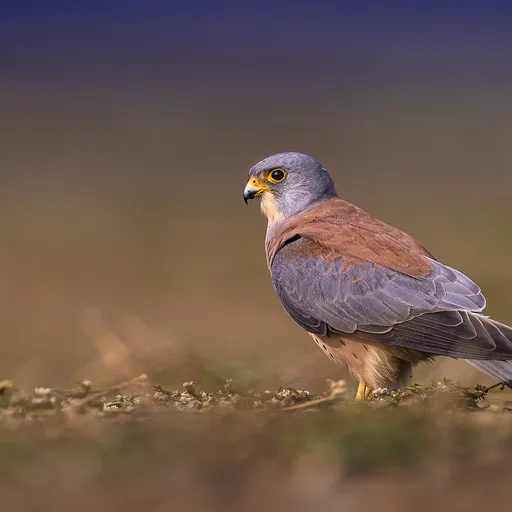
Lesser Kestrel
Falco naumanni
Least Concern
Overview
The lesser kestrel, Falco naumanni, is a small falcon that breeds across the Mediterranean, Central Asia, and East Asia. It is a summer migrant that winters in Africa and parts of South Asia, and is currently classified as Least Concern on the IUCN Red List.
Identification
- Small bird of prey measuring 27–33 cm in length with a wingspan of 63–72 cm, featuring proportionally shorter wings and tail than the common kestrel.
- Brown back with barred grey underparts; males have grey heads and tails and grey wing patches, lacking the dark back spotting and malar stripe of the common kestrel.
- Unusual whitish-horn coloured talons, a feature conspicuous only at close range.
- Distinctive diagnostic call described as a harsh chay-chay-chay, differing from the kee-kee-kee of the common kestrel.
Habitat
Breeding ranges extend from the Mediterranean across Afghanistan and Central Asia to China and Mongolia, while wintering grounds include Africa, Pakistan, and occasionally India and Iraq. The species is rare north of its breeding range and is experiencing a decline in its European range. During winter in West Africa, they favour a latitude belt through Senegal where locusts and grasshoppers are plentiful.
Diet
The lesser kestrel eats insects, small birds, reptiles, and rodents, especially mice, which are often taken on the ground. Indiscriminate pesticide use strongly affects the species due to its insectivorous habits.
Did you know?
A roost in Senegal discovered during a 2007 survey held 28,600 lesser kestrels roosting communally, together with 16,000 scissor-tailed kites.
Sources
- Wikipedia · CC BY-SA 4.0
- Wikidata · CC0 1.0