
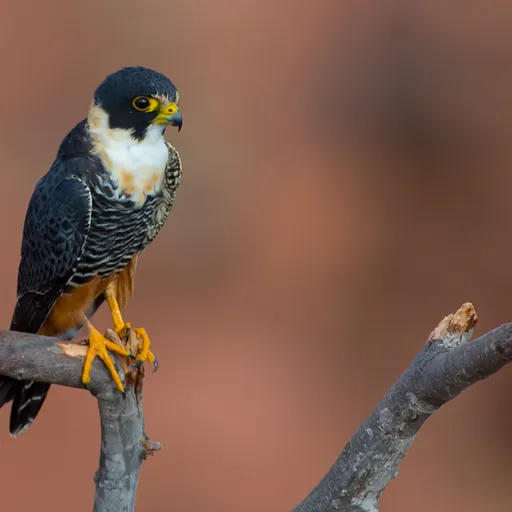
Bat Falcon
Falco rufigularis
Least Concern
Overview
The bat falcon (Falco rufigularis) is a bird of prey in the family Falconidae, characterized by its extensive distribution across the Americas. It is a small falcon, often noted for its close resemblance to the orange-breasted falcon and its status as a widespread but currently declining species due to habitat transformation.
Identification
- Adults possess a blue-black head and upperparts with greyish feather edges, contrasting with white to buff throat and upper breast that transitions into a black breast with fine white bars.
- The belly, thighs, and undertail coverts are chestnut-rufous, while the tail is blackish with thin white or greyish bars and a white or buff tip.
- Males weigh 108 to 150 g with a wingspan of 51 to 58 cm, whereas females are larger at 177 to 242 g with a wingspan of 65 to 67 cm.
- Juveniles are duller and browner than adults, featuring a buffier throat and black bars or spots on the undertail coverts.
Habitat
Found in Mexico, Central America, Trinidad, and most mainland South American countries except Chile and Uruguay, the bat falcon inhabits tropical forest environments. It favours unbroken mature forest but also utilises forest edges, gallery forests, wooded savannas, cleared land with remaining trees, and even suburban and urban areas, typically ranging from sea level to 1,700 m.
Diet
Perching conspicuously on high snags or hunting in sustained flight, bat falcons primarily forage at dawn and dusk. Their eclectic diet consists of bats, various birds, small rodents, snakes, lizards, frogs, and large insects, with vertebrates contributing the majority of the biomass consumed.
Did you know?
Despite its name, bats generally contribute less than 14% of the species' prey biomass, although some breeding pairs appear to specialise in hunting them.
Sources
- Wikipedia · CC BY-SA 4.0
- Wikidata · CC0 1.0