
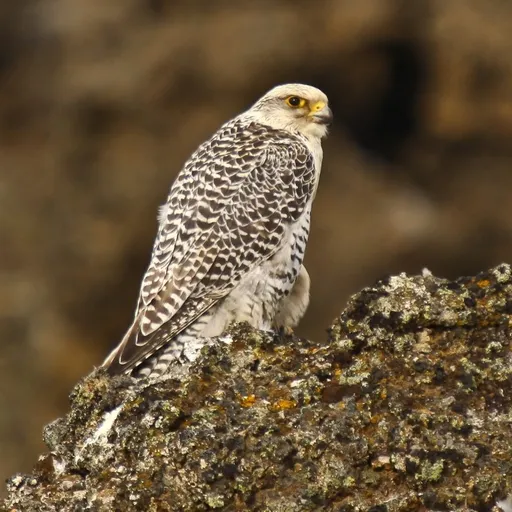
Gyrfalcon
Falco rusticolus
Least Concern
Overview
The gyrfalcon (Falco rusticolus) is a large bird of prey and the largest species in the falcon family, Falconidae. It is a high-latitude species that is mainly a resident on Arctic coasts and tundra, though some individuals disperse widely after the breeding season. Its conservation status is currently listed as Least Concern.
Identification
- Males measure 48 to 61 cm in length, while females are bulkier, ranging from 51 to 65 cm, with a wingspan of up to 134 cm.
- Plumage is highly polymorphic, varying from all-white to dark grey-brown, with archetypal morphs described as white, silver, brown, and black.
- The brown form is distinguished by cream streaking on the nape and crown and the absence of a well-defined malar stripe.
- Juveniles are typically darker and browner than adults, and the species shows no sex-based colour differences, though the black morph is mostly found in females.
Habitat
Gyrfalcons breed on the Arctic coasts and tundra of northern North America and Siberia, as well as the islands of northern regions. They are mainly resident species in these areas, although some individuals disperse widely after the breeding season or during winter, and individual vagrancy can take birds for long distances. A June 2011 discovery revealed that they also spend considerable periods during the winter on sea ice far from land.
Diet
The species feeds exclusively on birds and mammals, hunting in a horizontal pursuit rather than using a stoop. Typical prey includes ptarmigan, waterfowl, and small mammals such as Arctic ground squirrels and hares, with avian prey ranging in size from redpolls to geese and capercaillie. Most prey is killed on the ground, whether captured there or forced down from flight, though both male and female falcons can take down adult hares weighing up to 4.5 kg and bring dismembered pieces to their nest.
Did you know?
Due to its rarity and the difficulty involved in obtaining it, the gyrfalcon was historically reserved for kings and nobles in European falconry; very rarely was a man of lesser rank seen with a gyrfalcon on his fist. The bird's common name may derive from the Latin 'gyrus', meaning circle, referencing the species' circling flight as it searches for prey.
Sources
- Wikipedia · CC BY-SA 4.0
- Wikidata · CC0 1.0