
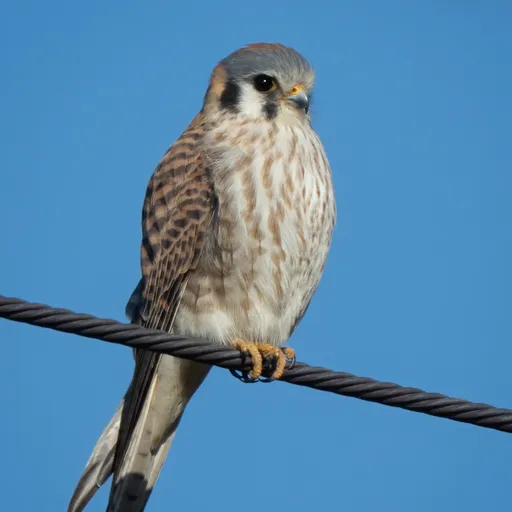
American Kestrel
Falco sparverius
Least Concern
Listen
XC250844 · Niels Krabbe · Azuay: upper Yunguilla Valley, Ecuador · CC BY-SA 4.0
Overview
The American kestrel (Falco sparverius) is the smallest and most common falcon in the Americas, distinguished by its wide distribution and adaptability. Though historically known as the sparrowhawk, it is a true falcon that exhibits significant sexual dimorphism in both size and plumage.
Identification
- Ranges from 22 to 31 cm in length with a wingspan of 51–61 cm, with females typically 10% to 15% larger than males.
- Males have blue-grey wings with black spots, white undersides with black barring, and a rufous back; females have rufous wings and backs with dark brown barring and creamy to buff undersides with heavy streaking.
- Both sexes feature a white head with a bluish-grey top, two narrow vertical black facial markings, and two black spots on the white or orangish nape.
- Vocalisations include a rapid 'klee' or 'killy' call, a 'whine' associated with feeding, and a 'chitter' used during social interactions.
Habitat
Occurring almost throughout North and South America, except for the Arctic fringes and the densest tropical Amazon rainforest, the species inhabits diverse environments such as grasslands, deserts, and urban areas provided they contain perches and nesting cavities. Its breeding range extends from Alaska and Canada down to Tierra del Fuego, with northern populations migrating south for the winter.
Diet
Feeding largely on small animals including grasshoppers, insects, lizards, mice, and small birds, the species occasionally takes prey as large as squirrels or snakes. It forages primarily by perching and scanning the ground, or by hovering in the air with rapid wing beats before striking its target.
Did you know?
Despite being the only kestrel found in the Americas, genetic analysis reveals it is not phylogenetically a true kestrel but is instead more closely related to all other non-kestrel falcons, having evolved its similar hunting traits through convergence.
Sources
- Wikipedia · CC BY-SA 4.0
- Wikidata · CC0 1.0