
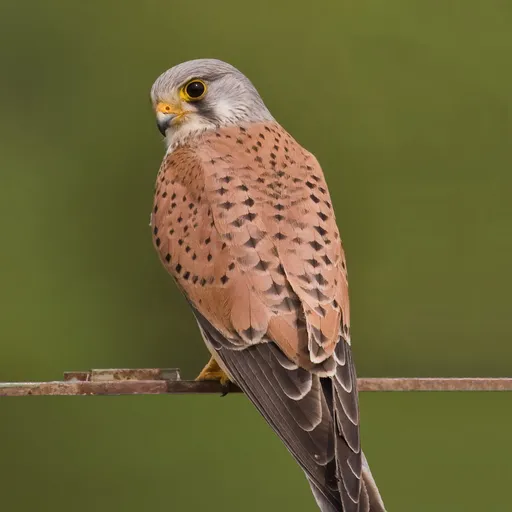
Common Kestrel
Falco tinnunculus
Least Concern
Listen
XC705934 · Sonothèque ADVL · Carolles, Manche, Normandie, France · CC0 1.0
Overview
The common kestrel (Falco tinnunculus) is a species of predatory bird in the falcon family, also known as the European or Eurasian kestrel. It is a widespread species found across Europe, Asia, and Africa, and is listed as Least Concern on the IUCN Red List.
Identification
- Measures 32–39 cm in length with a wingspan of 65–82 cm, appearing small compared with other raptors but larger than most songbirds.
- Plumage is mainly light chestnut brown with blackish spots on the upperside and buff with narrow blackish streaks on the underside; males have a blue-grey cap and tail, while females have fewer black spots than males but display brown tails with black bars.
- Features a prominent black malar stripe on the face, with bright yellow cere, feet, and eye rings, contrasted by dark toenails, bill, and iris.
- Males and females show sexual colour dimorphism, with males having fewer black spots and streaks and a distinct blue-grey head.
Habitat
This diurnal bird prefers open habitats such as fields, heaths, shrubland, and marshland, and can thrive in treeless steppe or arid savanna as long as perching sites are available. It is found from sea level to elevations of up to 4,500 m in tropical regions, though typically lower in subtropical areas. The common kestrel readily adapts to human settlements if sufficient vegetation remains, often nesting in cliffs, trees, or buildings.
Diet
The kestrel feeds almost exclusively on mouse-sized mammals such as voles, shrews, and mice, which provide up to three-quarters of its biomass, though it also consumes insects, lizards, and occasionally small birds. It requires the equivalent of 4–8 voles per day, depending on energy expenditure. Hunting involves hovering 10–20 m above the ground or perching above vegetation to spot prey, using keen eyesight and the ability to see near-ultraviolet light to detect rodent urine trails.
Did you know?
Kestrels can see near-ultraviolet light, which allows them to detect the urine trails around rodent burrows that shine in an ultraviolet colour in sunlight. They have also been used historically as decoys to capture other birds of prey in Persia and Arabia, and to train greyhounds in parts of Arabia.
Sources
- Wikipedia · CC BY-SA 4.0
- Wikidata · CC0 1.0