
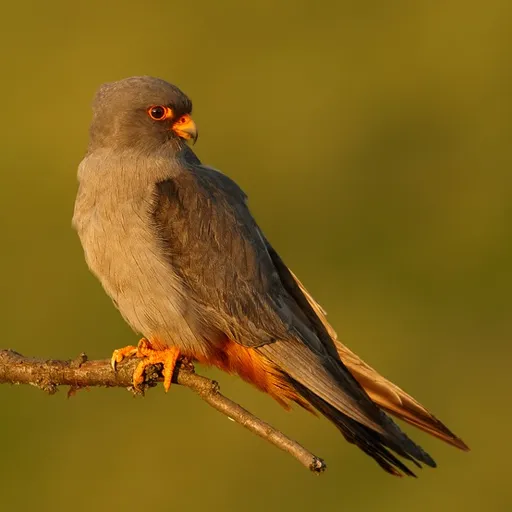
Red-footed Falcon
Falco vespertinus
Vulnerable
Overview
The red-footed falcon (Falco vespertinus), formerly known as the western red-footed falcon, is a medium-small bird of prey classified as Vulnerable on the IUCN Red List. It is a diurnal species that inhabits open steppe habitats across eastern Europe and Asia, where its population is dwindling rapidly due to habitat loss and hunting.
Identification
- Adult males are entirely blue-grey except for their red undertail coverts and legs, with uniformly grey underwings.
- Females display a grey back and wings, an orange head and underparts, and a white face marked by a black eye stripe and moustaches.
- Juveniles are brown above and buff below with dark streaks, featuring a facial pattern similar to the female.
- The species is medium-small in size, measuring 28–34 cm in length with a wingspan of 65–75 cm.
Habitat
This species resides in typical steppe environments that stretch from eastern Europe to Lake Baikal in central Asia, favouring open country with some trees, often near water. It breeds colonially by reusing the abandoned nests of corvids, such as rooks, which are typically situated 13–20 m above the ground near the edges of woodlands. While it breeds in Europe and Asia, the red-footed falcon migrates to winter in southern and eastern Africa.
Diet
The red-footed falcon hunts by hovering over the ground and making a steep dive, a method similar to the common kestrel. Its diet is varied, consisting of insects such as great green bush-crickets, as well as amphibians, reptiles, small mammals like the common vole, and bird nestlings. Younger nestlings receive larger prey items more frequently than older ones, whose diet shifts towards Orthoptera with fewer vertebrates.
Did you know?
In August 2004, a red-footed falcon was discovered on Martha's Vineyard in Massachusetts, marking the first recorded presence of the species in North America. Additionally, these birds may be closer to the merlin than to most other living falcons, though their exact relationships remain enigmatic.
Sources
- Wikipedia · CC BY-SA 4.0
- Wikidata · CC0 1.0