
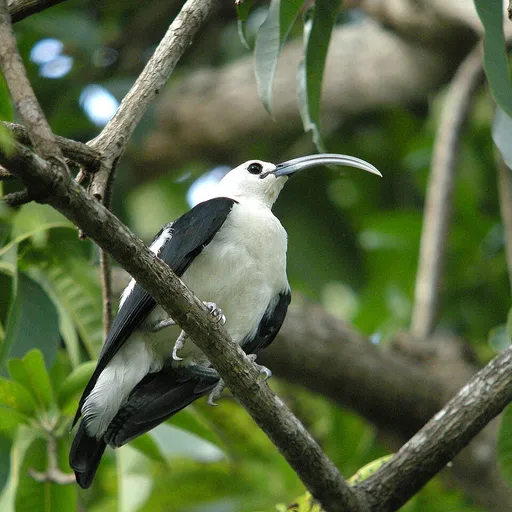
Sickle-billed Vanga
Falculea palliata
Least Concern
Overview
The Falculea palliata is a large, endemic bird species belonging to the vanga family, found exclusively in Madagascar. It is monotypic within its genus and recognised as the largest of the vangas.
Identification
- Length of 32 cm with a striking white head, breast and belly contrasted against a black back, wings and tail that possess a blue sheen.
- Features a strongly decurved, blue-grey bill measuring up to 77 mm that fades to ivory at the tip.
- Brown iris surrounded by a black orbital ring, with strong legs coloured dark grey to pale blue.
- Juveniles resemble adults but have buff tips on the black feathers of the back and wings.
Habitat
Endemic to Madagascar, this species inhabits the western side of the island from sea level up to 900 metres. It thrives in dry deciduous forests, thorn-forest, open savanna, and wooded areas around villages.
Diet
Feeds on a wide range of terrestrial invertebrates such as spiders, cockroaches, crickets, beetles and worms, as well as small vertebrates like chameleons and geckos. Forages by probing long bills into holes and leveraging off bark on large tree branches, effectively occupying the niche of woodpeckers which are absent in Madagascar.
Did you know?
The species shares a unique intense black colouration in the mouth with its close relatives, such as the white-headed vanga and Bernier's vanga. Its breeding system is polyandrous, with females courting multiple males who share the responsibility of raising the young.
Sources
- Wikipedia · CC BY-SA 4.0
- Wikidata · CC0 1.0