
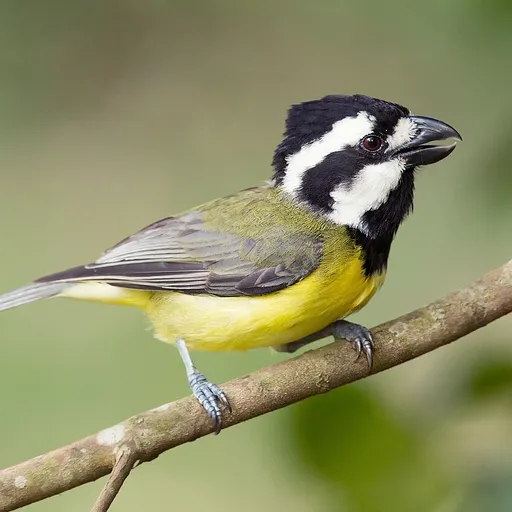
Eastern Shriketit
Falcunculus frontatus
Least Concern
Overview
The eastern shriketit (Falcunculus frontatus) is a passerine bird in the family Falcunculidae, endemic to Australia. Also known as the bark tit, crested tit or yellow-bellied tit, it is classified as Least Concern by the IUCN despite a decreasing population.
Identification
- Size: 15–19 cm in length with a wingspan of 24–29 cm.
- Plumage: Olive-brown to olive-green mantle, back and rump with yellow underparts. The head features broad white patches separated by a thick black eyeline and a black band running from the bill to the nape.
- Sexual Dimorphism: Males possess an erectable crest and a black throat, whereas females have an olive-brown throat and lack the crest.
- Vocalisation: Emits a weak, mellow and mournful whistle sounding like whiert, whit-whit, or wheeir, and can perfectly mimic many other species.
Habitat
Found in south-eastern Australia from the southeast of South Australia, throughout Victoria, eastern New South Wales to southeastern Queensland, with scattered occurrences further north and west. It primarily inhabits the canopy of eucalypt forests and open woodlands, and occasionally mallee, cypress-pine, coastal tea-tree, banksia, riverside trees or rainforests.
Diet
Feeds on spiders, beetles and insect larvae by foraging in the canopy, either in pairs or small groups. It uses its strong bill to lever up and tear bark to reveal prey, and has been observed holding a twig to poke into crevices for concealed insects.
Did you know?
The eastern shriketit exhibits tool-use behaviour by holding a twig in its bill to poke into crevices and extract hidden insects. Its nest is a deep cup of bark fibre bound with spider-web, placed in the highest twigs of a eucalypt sapling between 5–30 m above ground to protect it from predators.
Sources
- Wikipedia · CC BY-SA 4.0
- Wikidata · CC0 1.0