
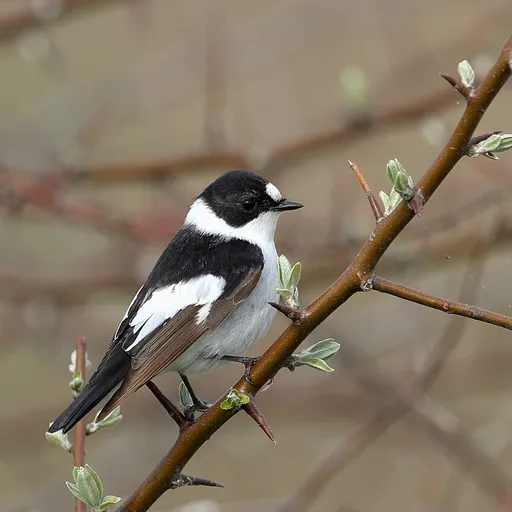
Collared Flycatcher
Ficedula albicollis
Least Concern
Listen
XC314779 · Alexander Kürthy · Forest at Little Danube, cadastre of Tureň, Senec District, Bratislava Region, Slovakia · CC BY-SA 4.0
Overview
The collared flycatcher (Ficedula albicollis) is a small passerine bird belonging to the Old World flycatcher family, distinguished as one of the four Western Palearctic black-and-white flycatchers. It is a migratory species that breeds in southeast Europe and winters in Sub-Saharan Africa, with isolated populations present in the Baltic islands of Gotland and Öland, Sweden.
Identification
- Breeding males display predominantly black upperparts and white underparts, highlighted by a white collar, large white wing patch, and a prominent white forehead patch.
- The bill is black, broad, and pointed, a shape typical of aerial insectivores.
- Non-breeding males, females, and juveniles feature pale brown plumage instead of black, making them difficult to distinguish from the European pied flycatcher or the semicollared flycatcher.
- The song consists of slow, strained whistles that are distinct from those of the pied flycatcher.
Habitat
These birds inhabit deciduous woodlands, parks, and gardens, showing a strong preference for old trees with cavities used for nesting. Their breeding range extends from Eastern France to the Balkan Peninsula and Ukraine, though they are rare vagrants in western Europe and have established isolated populations in Sweden.
Diet
Primarily feeding on insects taken in flight, this species also hunts caterpillars among oak foliage and occasionally consumes berries.
Did you know?
The collared flycatcher serves as a key model species in ecology and genetics, having been one of the first birds to have its full genome sequenced. Studies on the island of Öland have revealed that while hybridisation with the European pied flycatcher occurs in approximately 4% of the population, the resulting F1 hybrids suffer from severe fitness costs, including sterility and hatching failure.
Sources
- Wikipedia · CC BY-SA 4.0
- Wikidata · CC0 1.0