
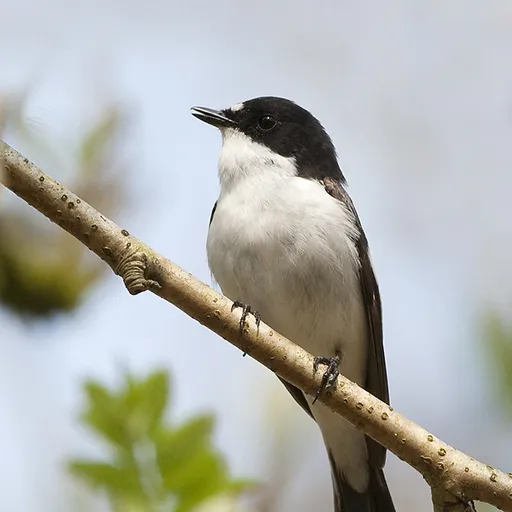
European Pied Flycatcher
Ficedula hypoleuca
Least Concern
Listen
XC803903 · Grégoire Chauvot · Leksand Municipality, Dalarnas län, Sweden · CC0 1.0
Overview
The European pied flycatcher (Ficedula hypoleuca) is a small passerine bird in the Old World flycatcher family. It is migratory, breeding across most of Europe and the Western Palearctic before wintering mainly in tropical Africa. This species occupies a very large range with a population size of 3–7 million pairs in Europe, classifying it as of least concern by the IUCN.
Identification
- Breeding males are black above and white below, featuring a large white wing patch, white tail sides, and a small forehead patch.
- Non-breeding males, females, and juveniles have the black plumage replaced by pale brown, making them difficult to distinguish from similar species.
- A 12–13.5 cm long bird with a black bill that is broad and pointed, typical of aerial insectivores.
- The song is loud, rhythmic, and melodious, characteristic of oak woods in spring, while the contact call is a short whistle described as 'whit, whit, whit'.
Habitat
These birds inhabit deciduous woodlands, parks, and gardens, showing a strong preference for oak trees. The species is typically terrestrial, occupying open forests, woodlands, and towns. It nests in holes in oak trees or open-fronted nest boxes, laying 4–10 eggs.
Diet
Mainly insectivorous, the diet includes caterpillars, flies, spiders, ants, and bees, along with other arthropods and berries. The bird forages by taking insects in flight and hunting caterpillars amongst oak foliage. Its broad, pointed bill is adapted for this aerial and foliage-foraging behaviour.
Did you know?
The species practices a mixed mating system of monogamy and polygyny, where males travel up to 3,500 metres to acquire a second mate but then return to the primary female to provide full-time care. While primary females benefit from this help, secondary females suffer, producing 60% fewer offspring than those in monogamous relationships.
Sources
- Wikipedia · CC BY-SA 4.0
- Wikidata · CC0 1.0