
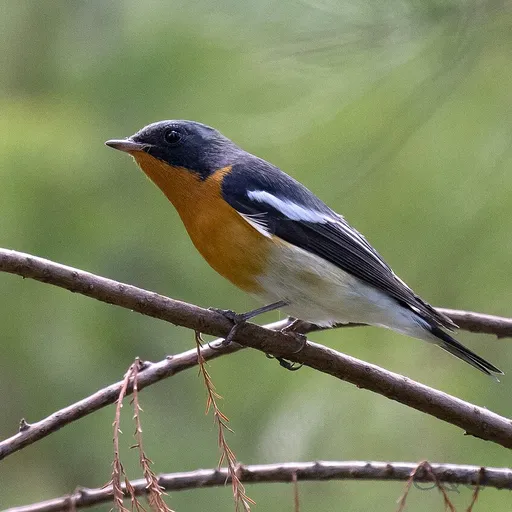
Mugimaki Flycatcher
Ficedula mugimaki
Least Concern
Overview
The mugimaki flycatcher (Ficedula mugimaki) is a small passerine bird of eastern Asia belonging to the Old World flycatcher family. Also known as the robin flycatcher, its Japanese name 'mugimaki' translates to 'wheat-sower'.
Identification
- 13 to 13.5 cm in length with a rattling call and a habit of flicking wings and tail.
- Adult males have blackish upperparts, a short white supercilium, white wing-patch, and orange-red breast and throat.
- Females are grey-brown above with a pale orange-brown breast, lacking white in the tail and having one or two pale wingbars instead of a white patch.
- Young males resemble females but possess a brighter orange breast and white in the tail.
Habitat
Breeding occurs in eastern Siberia and north-east China, with migration through eastern China, Korea, and Japan, and wintering in Southeast Asia up to western Indonesia and the Philippines. The main habitats are forest and woodland, particularly at higher elevations, though it is also found in parks and gardens during migration.
Diet
The species feeds on flying insects in the tree canopy.
Did you know?
A bird recorded in Humberside, England, in 1991 was initially classed as likely to be of captive origin rather than a wild vagrant, a status that persisted through reviews in 2009 and 2016 before the record was eventually reclassified.
Sources
- Wikipedia · CC BY-SA 4.0
- Wikidata · CC0 1.0