
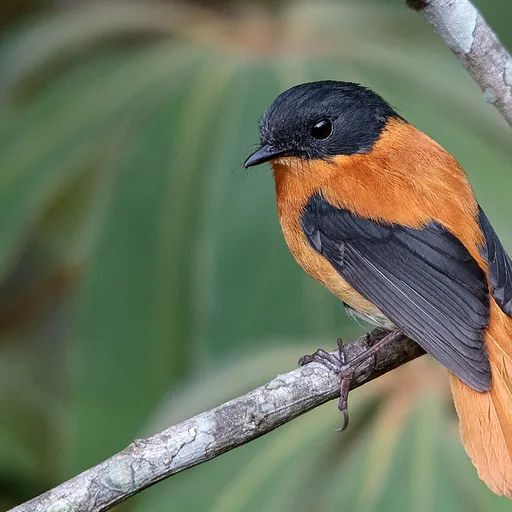
Black-and-orange Flycatcher
Ficedula nigrorufa
Least Concern
Overview
The black-and-orange flycatcher (Ficedula nigrorufa), also known as the black-and-rufous flycatcher, is a species endemic to the central and southern Western Ghats, Nilgiris, and Palni hill ranges in southern India. It is classified as Least Concern on the IUCN Red List and is distinguished within the Ficedula genus by its rufous back coloration.
Identification
- Males feature a distinct black head and black wings, while females have dark brown plumage replacing the black and possess a light eye-ring.
- Typically observed singly or in pairs, they occupy high-elevation plateaus above 1,500 m.
- Vocalisations include a repetitive "chee-ri-rirr" or whistling "whee-chee-ree-rirr", with a "keet-keet" threat display involving bill pointing and tail fanning.
- Young birds are brownish-orange with a whitish vent and stumpy orange tail, maturing to adult appearance after eight weeks.
Habitat
This species resides in high-elevation plateaus above 1,500 m in the Nilgiris, Palani Hills, Biligiriranga Hills, and Kannan Devan Hills, preferring open shola grassland with high leaf litter and undergrowth. The range extends north to Kudremukh National Park and the Bababudan Hills and south to the Ashambu Hills.
Diet
The bird feeds on insects by flycatching low over the ground, typically under 2 m in height, and by picking insects directly from the surface. Peak feeding activity occurs in the early morning and towards dusk, where they can capture up to 100 insects per hour.
Did you know?
The black-and-orange flycatcher is one of only two sedentary species in the genus Ficedula, alongside the rufous-chested flycatcher, lacking the longer, more pointed wing morphology required for long-distance migration.
Sources
- Wikipedia · CC BY-SA 4.0
- Wikidata · CC0 1.0