
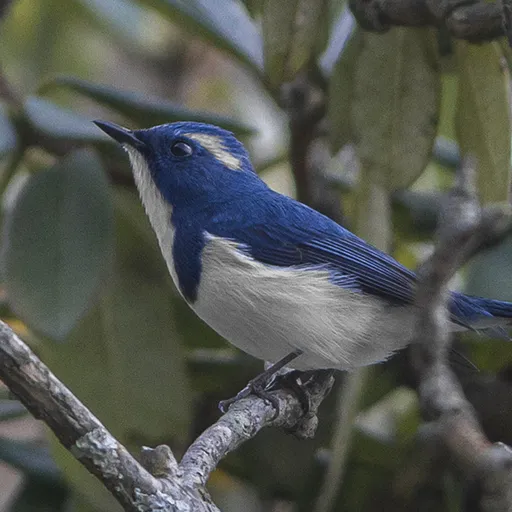
Ultramarine Flycatcher
Ficedula superciliaris
Least Concern
Overview
The ultramarine flycatcher, also known as the white-browed blue flycatcher, is a small arboreal Old World flycatcher in the genus Ficedula. It is classified as Least Concern on the IUCN Red List.
Identification
- Somewhat smaller than a sparrow at approximately 10 cm, with a stocky build.
- Males are deep blue above and on the sides of the head and neck, with a prominent white patch running from the centre of the throat through the breast to the belly.
- Amount of white on the brow and tail shows clinal variation; western subspecies have a distinctive white supercilium and white bases to outer tail feathers, while eastern subspecies lack distinct white patches.
- Constantly jerks up its tail, often accompanied by fluffing of head feathers and a 'trrr' note, especially near the nest.
Habitat
Breeding range extends from eastern Afghanistan to the Hengduan Mountains, occurring in open, mixed forests of oak, rhododendron, pine, and fir, as well as occasionally in orchards. It winters in central India from Delhi south to northern Maharashtra, Goa, and eastward to Andhra Pradesh and Odisha, with vagrants sometimes found in northern Bangladesh.
Diet
The diet consists mainly of insects. It feeds among the foliage canopy, keeping largely to low trees and bushes and not venturing much into the open, typically responding to indirect cues more than direct cues when foraging.
Did you know?
It readily takes to nest boxes in hill station gardens, where it constructs soft nests of fine moss, bark, and grass lined with hair and rootlets, often placing them in tree holes or clefts at heights up to seven metres.
Sources
- Wikipedia · CC BY-SA 4.0
- Wikidata · CC0 1.0