
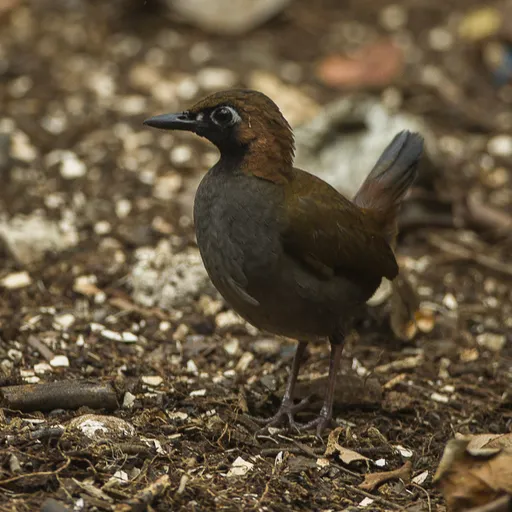
Black-faced Antthrush
Formicarius analis
Least Concern
Listen
XC249133 · Niels Krabbe · Orellana: 'Maxus' road km 37 (27 km SSE Pompeya), Ecuador · CC BY-SA 4.0
Overview
The black-faced antthrush (Formicarius analis) is a species of passerine bird in the family Formicariidae. It is a year-round resident found across a broad distribution in Central and South America, though it has a disjunct range with a notable gap in northwestern Brazil.
Identification
- Length ranges from 15 to 19 cm with a weight of approximately 50 to 75 g, featuring a dusky brown crown and a distinct black mask extending from the bill to the eye, chin, and throat.
- The bird has a small white spot on its lores, bare bluish skin around the eye, and grey to bluish legs, with flight feathers that are brown with a wide cinnamon band at the base.
- It sings an emphatic, flat-pitched introductory whistle followed by a series of lower-pitched whistles or a fast, sputtering trill, and can be identified by an 'emphatic short tleet!' call.
Habitat
This species inhabits primary and mature secondary forests, primarily in várzea and transitional forest, though it also occupies terra firme to a lesser extent. It is found from Honduras through Panama and across most mainland South American countries, excluding Argentina, Chile, Paraguay, and Uruguay, with a disjunct distribution that includes Trinidad.
Diet
The bird feeds primarily on a variety of arthropods, while also including small vertebrates such as frogs and lizards in its diet. It is almost entirely terrestrial, walking slowly with its tail cocked to sweep or flick aside leaf litter with its bill, and frequently attends army ant swarms to capture fleeing prey.
Did you know?
Rather than building a conventional nest, the black-faced antthrush creates a platform of dead leaves and flowers at the bottom of a tree or stump cavity, often located between 0.5 and 3.4 m above the ground.
Sources
- Wikipedia · CC BY-SA 4.0
- Wikidata · CC0 1.0