
Rufous-capped Antthrush
Formicarius colma
Least Concern
Listen
XC249084 · Niels Krabbe · Orellana: 'Maxus' road km 37 (27 km SSE Pompeya), Ecuador · CC BY-SA 4.0
Overview
The rufous-capped antthrush (Formicarius colma) is a small passerine bird belonging to the family Formicariidae. It is classified as a species of Least Concern on the IUCN Red List, although it is generally considered uncommon but widespread across northern and central South America.
Identification
- A small bird averaging 18 cm in length, with males weighing 38-49 grams and females 41-49 grams.
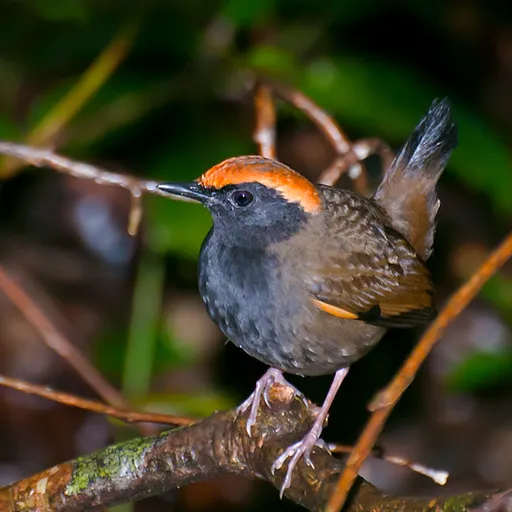
- Males feature a black forehead, rufous crown and nape, olive-brown upperparts, and a black neck, throat, and upper breast that merges into a dark grey lower breast and paler belly; females are similar but have a white throat instead of black.
- A black bill and brown iris, with legs ranging from light grey-brown to purplish-grey.
- The song is a fast, even-paced trill lasting 4 to 6 seconds at approximately 14 notes per second, described as 're-e-e-e-e-e-e-e-e-e-e-e-e-e-ee-ee-ee-ee-ee', while the call is a single, clear 'psee-eh' or 'pier'.
Habitat
Found in Bolivia, Brazil, Colombia, Ecuador, French Guiana, Guyana, Peru, Suriname, and Venezuela, primarily inhabiting the shady floor of tall, humid terra firme forests on solid ground. It is occasionally spotted in transitional várzea forests and savanna forests in Suriname, generally occupying lowlands up to 500 m and locally up to 1,100 m, though it may flee to higher and drier ravines and ridges due to interspecies aggression with other antthrush species.
Diet
The diet consists mainly of ants and grasshoppers, though they have also been known to occasionally eat snakes. They forage by walking slowly and tactfully on the forest floor, picking prey off leaf litter and flicking it away with their beaks. They usually hunt alone but have been observed hunting near each other in small groups on the periphery of ant swarms.
Did you know?
Their song, which sits between 2.2 and 3 kHz, is speculated to be the optimal frequency for communication in thick, humid underbrush. Rufous-capped antthrushes are rarely seen by humans but are often heard through their loud songs and calls.
Sources
- Wikipedia · CC BY-SA 4.0
- Wikidata · CC0 1.0