
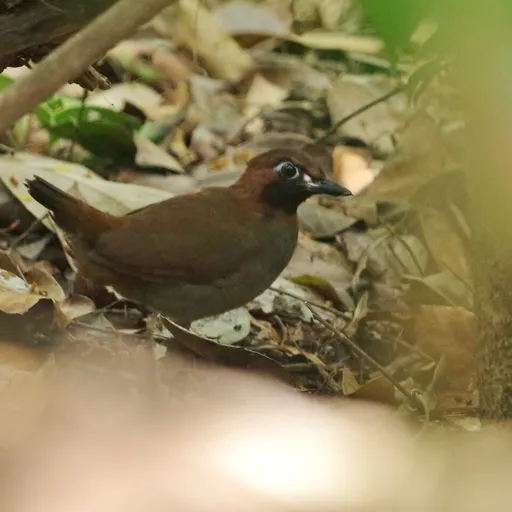
Mayan Antthrush
Formicarius moniliger
Least Concern
Listen
XC961545 · MANUEL DE JESUS HERNANDEZ ANCHEITA · Chiapas, Palenque Ruins, Mexico · CC0 1.0
Overview
The Mayan antthrush (Formicarius moniliger) is a species of bird in the family Formicariidae, first described by Philip Slater in 1857. It is currently classified as Least Concern by the IUCN, though its population is believed to be decreasing despite no immediate threats being identified.
Identification
- Size and build: 15 to 19 cm long with a weight of 56 to 64 g, possessing gray to bluish legs and a black bill.
- Plumage: Adults of the nominate subspecies feature a dusky brown crown, a black face and throat, rufous neck sides, brown upperparts with a rufescent rump, and uniform gray underparts with brown-washed flanks.
- Song: Characterised by an introductory whistle followed by 8–14 flat, rising, or falling whistles, often described as "piu...piupiupiupiupiupiupiupiu!".
- Call: An emphatic short "tleet!".
Habitat
Native to Belize, Guatemala, Honduras, and Mexico, the species inhabits humid evergreen, semi-deciduous, and deciduous forests, as well as coffee plantations and mature secondary forest. Its range extends from sea level up to approximately 1,800 m in elevation.
Diet
This species feeds primarily on a variety of arthropods. It forages almost entirely on the ground, walking slowly and deliberately with its tail cocked up like a rail.
Did you know?
The Mayan antthrush is highly sensitive to habitat fragmentation, with experimental evidence suggesting that pasture gaps wider than 50 m act as significant barriers to its movement between forest patches.
Sources
- Wikipedia · CC BY-SA 4.0
- Wikidata · CC0 1.0