
Black-headed Antthrush
Formicarius nigricapillus
Least Concern
Listen
XC248424 · Niels Krabbe · Pichincha: Río Guaycuyacu, Ecuador · CC BY-SA 4.0
Overview
The black-headed antthrush (Formicarius nigricapillus) is a small bird in the family Formicariidae found across parts of Central and South America. Classified as Least Concern by the IUCN, it is generally uncommon to locally fairly common and capable of surviving in isolated patches of forest.
Identification
- Approximately 18 cm long with a dark dusky brown to blackish crown and black face and throat, featuring a ring of bluish white bare skin around the eye.
- Upperparts are dark chestnut-brown or rufescent brown, while the belly is gray and undertail coverts are rufous; subspecies F. n. destructus has darker, less reddish-tinged upperparts.
- Possesses a black bill, brown iris, and dusky brown legs, with flight feathers showing dusky inner edges and a wide cinnamon band at the base.
- Song is a trill of about 10 notes per second that first falls then rises in pitch, accompanied by a short 'chweep' call.
Habitat
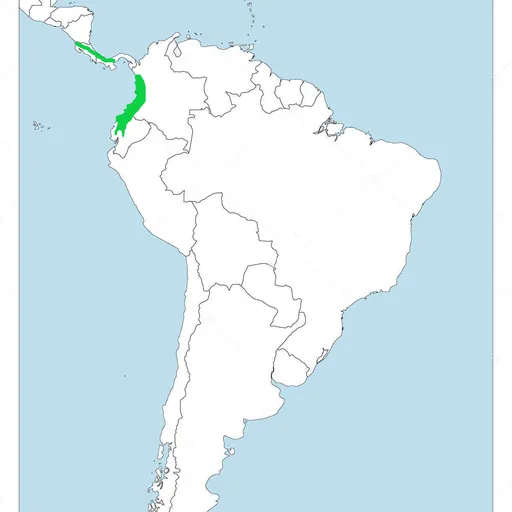
The species inhabits humid to wet primary and mature secondary forest, favouring ravines and areas with dense undergrowth. Its range is disjunct, covering the Caribbean slope of Costa Rica, both slopes of Panama, and the Pacific slope from central Chocó in Colombia through Ecuador, typically between 400 m and 1,500 m in elevation.
Diet
This almost entirely terrestrial bird feeds primarily on arthropods, including insects and spiders, as well as tiny reptiles and amphibians. It forages by walking slowly with its tail cocked, probing crevices, flicking aside leaf litter, and occasionally following army ant swarms to capture fleeing prey.
Did you know?
Both sexes sing, commonly from the ground, and the species is noted for its ability to survive in isolated and fairly small patches of forest despite its overall population decline.
Sources
- Wikipedia · CC BY-SA 4.0
- Wikidata · CC0 1.0