
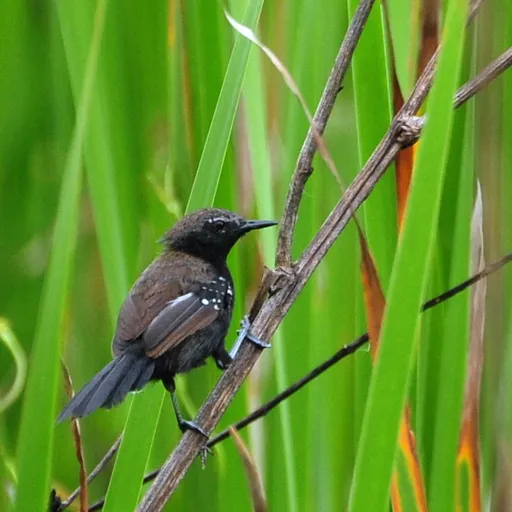
Marsh Antwren
Formicivora acutirostris
Near Threatened
Overview
The marsh antwren (Formicivora acutirostris) is an insectivorous bird in the family Thamnophilidae, endemic to southeastern Brazil. It comprises two subspecies and is currently classified as Near Threatened by the IUCN, though the taxonomy remains unsettled with some authorities treating the subspecies as separate species.
Identification
- Length of 13 to 15 cm and weight of 8 to 12 g.
- Nominate males feature a lead gray face with an ill-defined pale supercilium and a whitish crescent below the eye, contrasting with dark chestnut-olive upperparts.
- F. a. paludicola males possess a white supercilium on a black face and black underparts with black-tipped white underwing coverts.
- Song consists of doublets of abrupt notes or rapidly repeated double-note phrases with slight modulations.
Habitat
The species inhabits coastal and riverine marshes with fluctuating water levels, occasionally extending into flooded plains and mangrove transition zones. It is found in a disjunct distribution in southeastern Brazil, ranging from sea level to 760 m, and prefers dense vegetation less than 1 m high.
Diet
The diet appears to be largely or entirely arthropods, though it has not been detailed. The bird forages singly, in pairs, or in family groups by actively gleaning from grass, reeds, and leaves, using short jumps or brief sallies to reach the underside of leaves.
Did you know?
The nest of the nominate subspecies is a cup woven from plant fibers, silk from spiderwebs, and arthropod cocoons, often incorporating leaf fragments and hung within 2 m of the substrate.
Sources
- Wikipedia · CC BY-SA 4.0
- Wikidata · CC0 1.0