
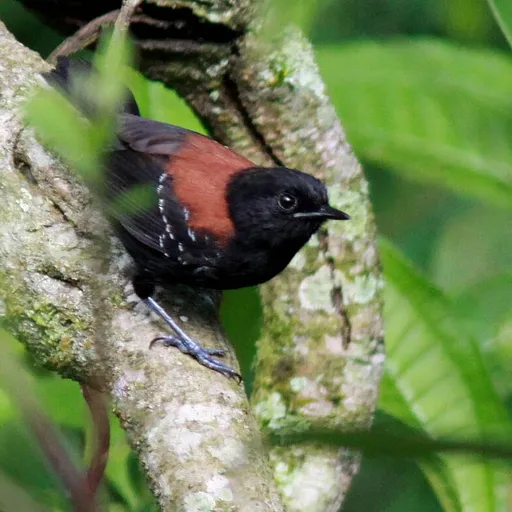
Black-hooded Antwren
Formicivora erythronotos
Endangered
Overview
The black-hooded antwren, Formicivora erythronotos, is an endangered bird in the family Thamnophilidae. It is a year-round resident endemic to Brazil, specifically found in the narrow coastal plain of Rio de Janeiro state.
Identification
- Males are almost entirely black with a deep rufous back, rump, and uppertail coverts, white wing-covert tips, white flanks, and barred undertail coverts.
- Females have deep rufous upperparts but are mostly olive-brown, which is paler and buffier on the underparts, with variable thin dark streaks or mottling on the head and throat.
- Adults measure 11 cm in length and possess a slim black bill.
- The song is a high, level, rattling 'tjotjotjo---' lasting 2–3 seconds, while calls include a soft 'chep-ep' and an explosive, nasal descending note that is often doubled.
Habitat
The species inhabits areas in the early stages of succession, such as young second growth, secondary forest, and abandoned banana plantations reverting to forest. It is restricted to several subpopulations along the coast of Baía da Ilha Grande in Rio de Janeiro state.
Diet
The diet consists of insects, spiders, and small frogs, which are obtained by gleaning from live leaves, vines, branches, and stems. Foraging occurs singly, in pairs, or in family groups between the ground and 3 m above it, occasionally reaching 7 m, and does not involve following army ant swarms.
Did you know?
After being known only from about 20 specimens collected in the 19th century, the species remained unseen for more than 100 years until it was rediscovered in 1987.
Sources
- Wikipedia · CC BY-SA 4.0
- Wikidata · CC0 1.0