
Sincora Antwren
Formicivora grantsaui
Vulnerable
Overview
The Sincorá antwren (Formicivora grantsaui) is a small passerine bird in the subfamily Thamnophilinae, restricted to a limited area in eastern Brazil. First described in 2007 from specimens collected near Mucugê in Bahia, the species was initially assessed as Near Threatened by the IUCN in 2011 before being downlisted to Vulnerable in 2025.
Identification
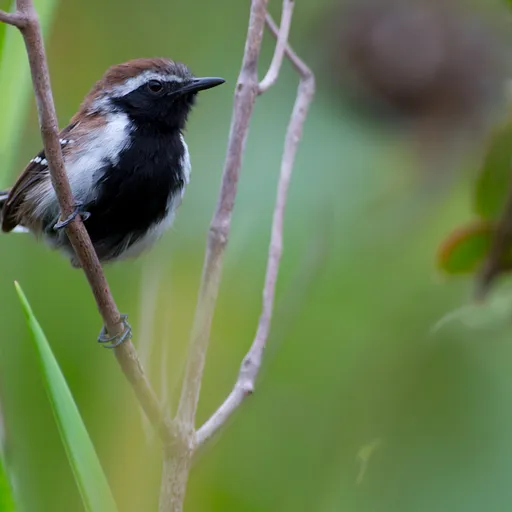
- Males feature a white supercilium extending down the neck and along the sides of the breast, with a black face, throat, and underparts contrasted by deep brown flanks and grayish-white underwing coverts.
- Females display a paler brown crown and back, a thin black eye band, and a whitish face, throat, and breast marked with wide black streaks.
- Both sexes have dark brown irises, dark plumbeous gray legs and feet with yellow soles, and a black bill that is slightly bluish-gray at the base in females.
- The song consists of a slow series of very short, very high 'tjew' notes, accompanied by a distinctive two-part alarm call containing usually more than two notes.
Habitat
The Sincorá antwren is endemic to the Serra do Sincorá, located at the eastern edge of the Chapada Diamantina region in Bahia, Brazil. It inhabits campo rupestre, a biome characterized by scrub and grasses growing on poor soil among sandstone rocky outcrops, at elevations ranging between 850 and 1,100 m.
Diet
Although specific dietary details are not yet confirmed, the species is assumed to feed on arthropods similarly to other members of its genus, typically foraging in pairs or family groups.
Did you know?
The species was first identified in 2007 from specimens originally collected by a German-born naturalist in 1965, with the scientific name specifically honouring Rolf Grantsau's contribution to ornithology in that region.
Sources
- Wikipedia · CC BY-SA 4.0
- Wikidata · CC0 1.0