
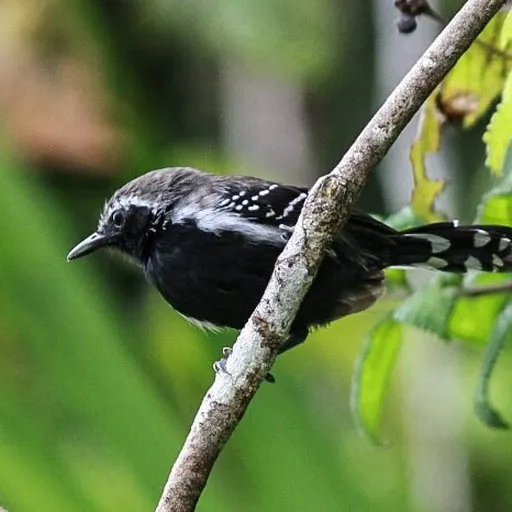
Southern White-fringed Antwren
Formicivora grisea
Least Concern
Overview
The southern white-fringed antwren (Formicivora grisea) is an insectivorous bird in the family Thamnophilidae, commonly known as the typical antbirds. It is classified as Least Concern by the IUCN due to its very large range, despite a believed decrease in population size.
Identification
- Males have a white supercilium extending down the neck and along the breast, contrasting with black underparts and dark grayish-brown upperparts.
- Females possess a buff supercilium, mottled faces, and cinnamon underparts.
- Males sing a monotone song consisting of a single soft 'chup' note repeated up to 50 times, as well as complex 'churet' or 'chuweet' notes.
Habitat
Found in Brazil, Colombia, French Guiana, Guyana, Suriname, and Venezuela, the species inhabits a variety of wooded landscapes, favouring the understorey and mid-storey at forest edges. It occurs in habitats ranging from mangroves and restinga scrublands to tropical deciduous forests and secondary growth, typically below 1,000 m elevation but reaching up to 1,600 m in Venezuela.
Diet
This bird feeds on a wide variety of insects and spiders, foraging actively by gleaning from live leaves, vines, and stems. It usually forages from the ground to 5 m above it, but can reach as high as 13 m in gallery and deciduous forests, occasionally following army ant swarms in Amazonian Brazil.
Did you know?
The southern white-fringed antwren was previously considered the same species as the northern white-fringed antwren, but they were split based on their very different vocalizations.
Sources
- Wikipedia · CC BY-SA 4.0
- Wikidata · CC0 1.0