
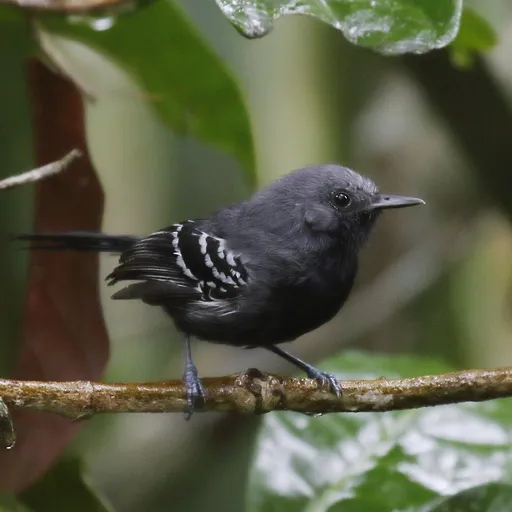
Narrow-billed Antwren
Formicivora iheringi
Least Concern
Overview
The narrow-billed antwren (Formicivora iheringi) is a species of bird in the family Thamnophilidae, commonly known as the typical antbirds. It is endemic to eastern Brazil and is currently listed as a species of Least Concern by the IUCN.
Identification
- Length of 11 to 12 cm with a longish bill and tail.
- Adult males are mostly dark gray with blackish wings and tail, white wing tips, a black throat and breast, white flanks, and barred undertail coverts.
- Adult females possess olive-brown upperparts with a grayer crown, a pale supercilium, and a whitish eye ring.
- Females have reddish-brown tails and yellow-ochre underparts that are nearly whitish on the belly.
- Song consists of a series of very high, loud 'tiúw' notes delivered at a rate of two per second over eight seconds.
Habitat
The species inhabits the understorey to mid-storey of deciduous forests and, in parts of Bahia, the open understorey of mata-de-cipó biome. It is found in the eastern Brazilian states of Bahia and Minas Gerais at elevations between 250 and 1,100 m. Its distribution is disjunct and inland from the coast, where it occurs in pockets and is considered a year-round resident.
Diet
The diet comprises insects and probably spiders. The bird forages actively but methodically, picking at stems and limbs in woody vine tangles and on open branches, often hitching along them. It also gleanses from live leaves, dead leaf clusters, and moss while perched, and occasionally makes short sallies to capture moths in flight.
Did you know?
Despite the species being assessed as 'Least Concern' since 2023, it does not occur in any formally protected areas, relying on remaining habitat pockets in the Jequié-Boa Nova and Almenara regions that lack legal protection.
Sources
- Wikipedia · CC BY-SA 4.0
- Wikidata · CC0 1.0