
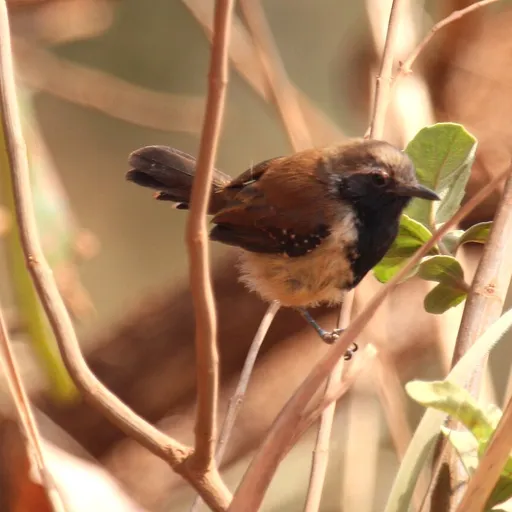
Rusty-backed Antwren
Formicivora rufa
Least Concern
Overview
The rusty-backed antwren (Formicivora rufa) is a species of bird in the family Thamnophilidae, commonly known as the typical antbirds. It is assessed as Least Concern by the IUCN, with a large range and a believed stable population.
Identification
- Males possess a tawny rufous crown and upperparts, a white supercilium, and a black face and throat.
- The breast features a black centre edged in white, separating it from cinnamon-buff flanks, while the belly is white.
- Adults measure 12 to 13 cm in length and weigh between 11.5 and 14 g.
- The song consists of a long rattle of evenly pitched harsh or sharp notes, often increasing in intensity, alongside common calls described as an explosive 'chip cheep' or 'tit-tweep'.
Habitat
Found in Bolivia, Brazil, Paraguay, Peru, and Suriname, the bird inhabits semi-open to open landscapes such as cerrado, campos with scattered trees, white sand forest, and scrublands. Its elevation range extends from sea level in the east up to 1,450 m in Peru and Bolivia, where it is believed to be resident throughout its range.
Diet
The diet includes insects and is thought to also include spiders. It is an active forager that hops through the interior of bushes and small trees, making short sally flights to glean prey from foliage. Unlike some other antbirds, it does not appear to follow army ant swarms.
Did you know?
Although the species name suggests it might rely on ant swarms for food, the rusty-backed antwren does not appear to follow army ants. In São Paulo, a single observed nest was constructed as a deep cup of grass stems placed in the fork of a twig within a small bush.
Sources
- Wikipedia · CC BY-SA 4.0
- Wikidata · CC0 1.0