
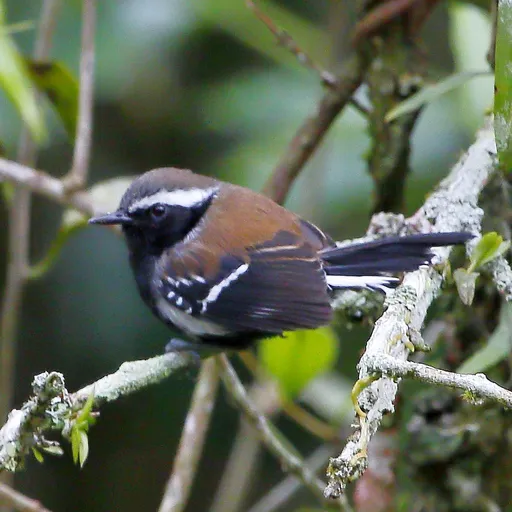
Serra Antwren
Formicivora serrana
Least Concern
Overview
The serra antwren (Formicivora serrana) is a small insectivorous bird belonging to the typical antbird family, endemic to southeastern Brazil. It comprises three subspecies, two of which inhabit inland forested areas while the third is restricted to coastal restinga habitats.
Identification
- Males of the nominate subspecies display rufous-brown upperparts and black underparts, featuring a white supercilium that extends down the neck and breast.
- Females have wide black eye bands with entirely creamy white underparts, a stark contrast to the darker males.
- Adults measure 12 to 14 cm in length and weigh between 10 and 13 g.
- Vocalizations include a monotonous series of dry chup notes, a short downslurred nasal whine, and high-pitched squeaky kee-ip notes.
Habitat
The species inhabits the understorey of semi-humid evergreen forests, secondary woodlands, and drier scrublands, with the nominate subspecies favouring stunted forest on rocky soils up to 1,550 m above sea level. The coastal subspecies F. s. littoralis is restricted to the restinga biome, characterized by dense scrub, cacti, and bromeliads on sandy coastal plains.
Diet
Although not extensively detailed, the diet is assumed to consist of insects, spiders, and other small arthropods. The bird forages actively in dense vegetation, typically gleaning prey from live leaves, vines, and branches while perched 1 to 2 m above the ground.
Did you know?
Males of the Formicivora genus are unusual among antbirds for having underparts that are darker than their upperparts. Despite earlier taxonomic separation, the coastal restinga antwren was restored to subspecies status after studies showed it shares nearly identical vocalisations with the inland forms.
Sources
- Wikipedia · CC BY-SA 4.0
- Wikidata · CC0 1.0