
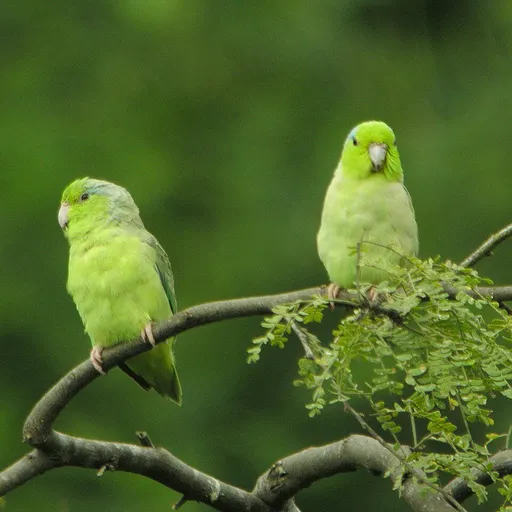
Pacific Parrotlet
Forpus coelestis
Least Concern
Overview
The Pacific parrotlet, also known as Lesson's parrotlet or the celestial parrotlet, is a small green parrot in the family Psittacidae native to South America. Despite its tiny stature, it is renowned for having a larger-than-life personality and a feisty attitude.
Identification
- A small green parrot measuring 11–14 cm in length and weighing at least 30 g.
- Features a pinkish beak and pinkish-grey legs and feet, with a bright green mask and a dusty grey cast over the body.
- Males display blue wings ranging from cobalt to lavender, blue 'eyeshadow' streaks behind the eyes, and blue rumps, whereas females lack blue on the wings though they may possess blue eye streaks and a blue rump.
- Produces high-pitched, rapid 'tchit' calls that create a constant chattering sound when in a flock.
Habitat
Native to western Ecuador and northwestern Peru, with a small reported population in southwestern Colombia. This non-migratory species predominantly inhabits dry environments such as deserts and deciduous forests, though it has expanded into humid areas due to deforestation. It is frequently found in flocks of 40 to 50 birds in lowlands, foothills, woodlands, shrubby clearings, gardens, and agricultural crops.
Diet
Wild Pacific parrotlets primarily feed on berries and cactus fruits, though they are not particularly selective in their feeding habits. In captivity, they consume a wide variety of fruits, seeds, vegetables, and herbs, which can be prepared as fresh 'chop' or blended and frozen for later use.
Did you know?
In the wild, these birds have been observed nesting in the abandoned nests of necklaced spinetails and pale-legged horneros, as well as in tree cavities or on fence posts. Each clutch contains 4–6 white eggs, and the species is notably protective of its offspring.
Sources
- Wikipedia · CC BY-SA 4.0
- Wikidata · CC0 1.0