
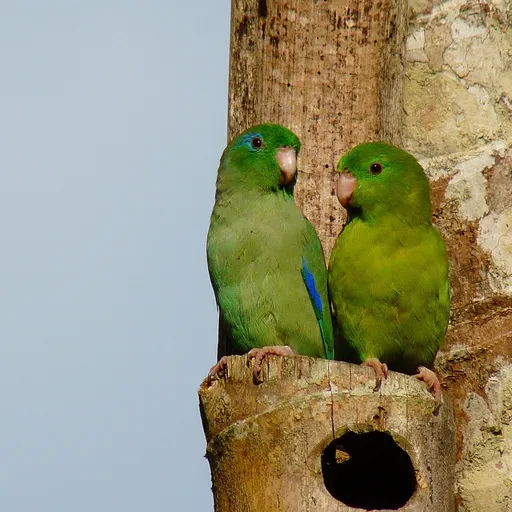
Spectacled Parrotlet
Forpus conspicillatus
Least Concern
Overview
The spectacled parrotlet (Forpus conspicillatus) is a species of parrot in the family Psittacidae, classified as Least Concern on the IUCN Red List. It is native to Middle and South America, with three recognised subspecies including the Cauca and Venezuelan spectacled parrotlets.
Identification
- Exhibits green and blue plumage that provides camouflage against tropical trees.
- Capable of differentiating between social companions and adapting calls to mimic the specific call of the bird it is communicating with, sometimes described as 'names'.
- Calls range between tweeting, chirping or buzzing sounds depending on the information being relayed.
Habitat
Spectacled parrotlets are endemic to northern and central Colombia, Venezuela, and eastern Panama, inhabiting lowland evergreen forest edges, thorn scrub, llanos, and gallery woodland. They prefer open habitats and are found at altitudes not exceeding 1,600 metres (5,200 ft). Their populations are stable or possibly increasing, as they thrive in heavily degraded former forests and low-density woodland.
Diet
In the wild, they feed on seeds, nuts, leaves, berries, cactus, Tamarindus sp., and other fruits, occasionally consuming small insects. They are also observed licking or eating clay, which provides essential minerals such as calcium.
Did you know?
The bright color of the male and specific mating calls attract the female, and males are known to be better mimickers than females in captivity due to the instinctive nature of calling to attract a mate in the wild. Additionally, spectacled parrotlets can be seen in large flocks of up to 100 individuals on clay mounds drinking runoff or eating clay.
Sources
- Wikipedia · CC BY-SA 4.0
- Wikidata · CC0 1.0