
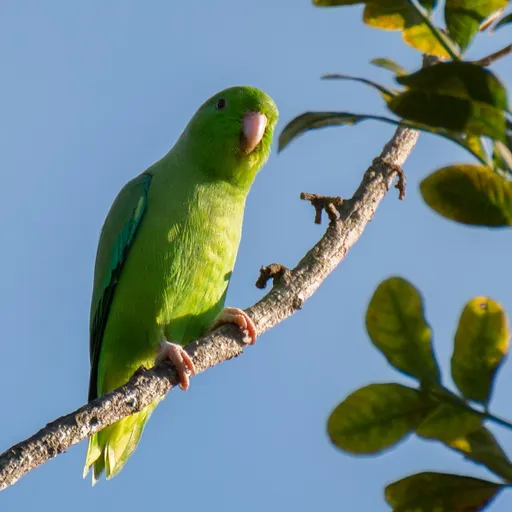
Green-rumped Parrotlet
Forpus passerinus
Least Concern
Overview
The green-rumped parrotlet (Forpus passerinus), also known as the green-rumped parakeet, is a species of parrot in the family Psittacidae found in northeastern South America and the Caribbean island of Trinidad. It is a widespread and common species, though populations are currently decreasing due to habitat destruction.
Identification
- Length of 12 cm with a weight of 20–28 g, featuring a bright green plumage and duller, grayer napes.
- Males display purplish-blue primaries, secondaries, and coverts with bright turquoise feathers on the leading edges of the wings, whereas females lack blue and show more yellow-green on the head.
- Dark brown eyes contrast with light peach beaks and feet.
- Juveniles resemble adults, while males of specific subspecies exhibit variations in the extent and intensity of their purple-blue markings.
Habitat
This species inhabits tropical South America from the Caribbean regions of Colombia, Venezuela, and Trinidad south and east to the Guianas and Brazil on the lower Amazon River. It prefers open, semi-arid environments such as dry scrubland, deciduous woodland, gallery forest, farmland, and forest edges, though it has also been introduced to Jamaica, Curaçao, Barbados, and Tobago. Green-rumped parrotlets do not occur at altitudes greater than 1,800 metres above sea level.
Diet
Primarily feeding on seeds from grasses and forbs, this parrot also consumes flowers, buds, berries, and fruits. They have been observed eating seeds from fruit trees, including Annona sp. and guava.
Did you know?
Green-rumped parrotlets practice asynchronous hatching, which results in chicks of different sizes within the same clutch; consequently, male parents tend to feed the larger chicks more often, while females prioritise the smaller individuals due to their more intense begging behaviours.
Sources
- Wikipedia · CC BY-SA 4.0
- Wikidata · CC0 1.0