
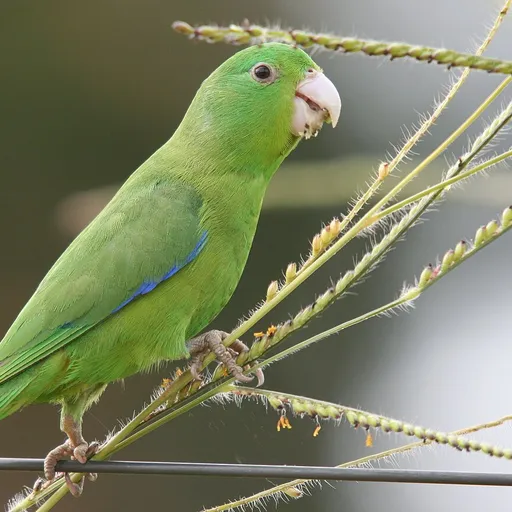
Cobalt-rumped Parrotlet
Forpus xanthopterygius
Least Concern
Overview
The cobalt-rumped parrotlet, also known as the blue-winged parrotlet, is a species of parrot in the family Psittacidae. It is generally common and widespread across much of central and northern South America, though its status is classified as Least Concern on the IUCN Red List.
Identification
- Calls consist of high-pitched "sheet" or "zeet" screeches or twittering, with chattering noises when feeding and socializing in large groups.
- The species has two subspecies: Salvadori's cobalt-rumped parrotlet (F. x. flavescens) and Hellmayr's cobalt-rumped parrotlet (F. x. flavissimus).
- No specific physical details regarding plumage, size, bill, or legs are provided in the reference material.
Habitat
Cobalt-rumped parrotlets inhabit lowlands across central and northern South America, preferring dry and riparian woodlands, cerrado, caatinga, palm groves, semi-arid scrubland, savanna, and pastures. They tend to avoid densely forested areas and are not found at altitudes above 1,200 metres. While generally non-migratory, some populations move locally with flowering seasons or altitudinally in the Brazilian Atlantic Forest.
Diet
This species primarily feeds on Cecropia sp. and Ficus sp. fruits, Mikania sp. and Trema micrantha seeds, and flowers from Ambrosia sp., Handroanthus serratifolius, and Marcgravia sp., occasionally consuming grass. They forage socially in groups of two to twelve individuals, often forming flocks of around twenty or more near fruiting trees or seeding grasses.
Did you know?
Cobalt-rumped parrotlets have been observed scraping rufous hornero nests made of clay with their beaks, potentially to taste-test the material for suitability or to obtain important minerals through clay-licking.
Sources
- Wikipedia · CC BY-SA 4.0
- Wikidata · CC0 1.0