
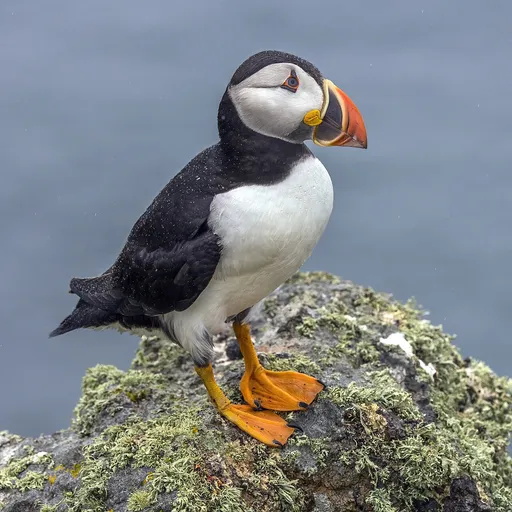
Atlantic Puffin
Fratercula arctica
Vulnerable
Listen
XC821150 · Killian Sullivan · Grand Manan, United States · CC0 1.0
Overview
The Atlantic puffin, Fratercula arctica, is a seabird in the auk family and the only puffin species native to the Atlantic Ocean. It is the sole member of its genus to occur in the Atlantic, distinct from the tufted and horned puffins found in the Pacific.
Identification
- Sturdily built with a thick neck and short wings, standing approximately 20 cm high on land with a direct, low flight pattern.
- Glossy black crown, back, and wings contrasting with white underparts and pale grey, lozenge-shaped cheek patches.
- Distinctive broad, triangular bill that is orange-red at the tip and slate grey near the head, separated by a yellow chevron.
- Bright orange legs and webbed feet with sharp black claws; the bill becomes plainer and the face darker in winter plumage.
Habitat
A bird of the colder North Atlantic waters, it breeds on the coasts of northwest Europe, the Arctic fringes, and eastern North America. It spends most of the year in the open ocean, returning to clifftop colonies with burrows during the breeding season. Islands are particularly attractive for nesting to avoid terrestrial predators.
Diet
The diet consists almost entirely of fish, such as sand eels, herring, capelin, and sprats, though it occasionally consumes crustaceans, molluscs, and polychaete worms. It forages by swimming underwater, using its wings as paddles and feet as a rudder to reach considerable depths.
Did you know?
The Atlantic puffin is known as the official bird of the Canadian province of Newfoundland and Labrador, as well as nicknames like the 'clown of the sea' or 'sea parrot' due to its striking appearance and waddling gait.
Sources
- Wikipedia · CC BY-SA 4.0
- Wikidata · CC0 1.0