
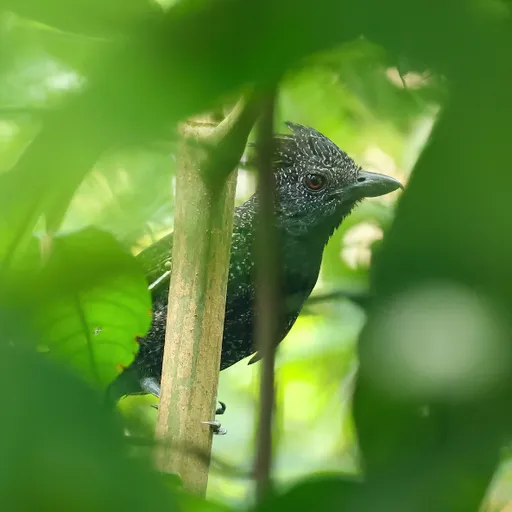
Fulvous Antshrike
Frederickena fulva
Listen
XC250849 · Niels Krabbe · Sucumbíos: Mirador de Lumbaqui, Ecuador · CC BY-SA 4.0
Overview
The fulvous antshrike (Frederickena fulva) is a large, dark antbird belonging to the family Thamnophilidae. Its taxonomic status remains unresolved, with some authorities treating it as a full species while others consider it a subspecies of the undulated antshrike.
Identification
- A large antbird measuring 22 to 25 cm in length, with a prominent crest and a heavy black bill featuring a shrike-like hook.
- Adult males are predominantly black with irregular thin white bars, while adult females are rich cinnamon with wavy black bars.
- Both sexes possess brown to orange-yellow irises and black or dark gray legs.
- The song consists of a steadily repeated series of whistled notes described as 'uué, uué, uué...', accompanied by calls such as a nasal snarl or descending squeals.
Habitat
This species inhabits lowland evergreen forests, such as terra firme, in the far western Amazon Basin, favouring dense, viny vegetation in the understorey. Its range extends across southern Colombia, the eastern half of Ecuador, and northern Peru, reaching elevations of up to 700 m, though potentially as high as 1,100 m in Peru.
Diet
Although its specific diet is not detailed, it is assumed to consume large insects and other arthropods. The bird forages singly or in pairs within dense foliage and vine tangles near the ground, hopping between branches and gleaning prey while typically jerking its tail sideways.
Did you know?
Despite its rarity, the fulvous antshrike occasionally joins mixed-species feeding flocks, and there is a single recorded instance of it following an army ant swarm.