
Magnificent Frigatebird
Fregata magnificens
Least Concern
Overview
The magnificent frigatebird (Fregata magnificens) is the largest species of frigatebird, a large, lightly built seabird found in tropical and subtropical waters off the Americas. It is one of the fastest birds in the world, capable of flying at speeds up to 153 kilometres per hour.
Identification
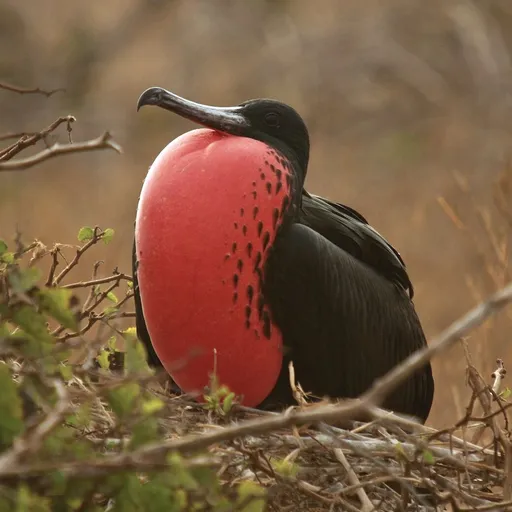
- Males are all-black with a scarlet throat pouch that inflates like a balloon during breeding, while females have a white breast, lower neck sides, a brown band on the wings, and a diagnostic blue eye-ring.
- The bird possesses long, narrow wings and a deeply forked tail, with males exhibiting purple iridescence in the scapular feathers when reflecting sunlight.
- It is silent in flight but makes various rattling sounds at the nest.
- Immature birds have a white head and underparts, and juveniles display a distinctive diamond-shaped belly patch.
Habitat
The species occurs over tropical and subtropical waters off America, ranging between northern Mexico and Peru on the Pacific coast and between Florida and southern Brazil on the Atlantic coast. Populations also reside on the Galápagos Islands and the Cape Verde islands, with breeding colonies established in trees on islands and cays.
Diet
This species feeds mainly on fish, squid, jellyfish, and crustaceans, taking prey in flight from the ocean's surface, often targeting flying fish. It also engages in kleptoparasitism, harassing other seabirds to force them to regurgitate their food, which the frigatebird then catches in mid-air.
Did you know?
The bird is capable of crossing the Isthmus of Panama, a geological barrier that impedes most tropical seabirds, indicating significant gene flow between Atlantic and Pacific localities. However, the Galápagos population has been genetically and morphologically isolated from mainland counterparts for several hundred thousand years.
Sources
- Wikipedia · CC BY-SA 4.0
- Wikidata · CC0 1.0