
Great Frigatebird
Fregata minor
Least Concern
Overview
The great frigatebird (Fregata minor) is a large, lightly built seabird belonging to the frigatebird family, characterised by its extensive tropical distribution. Classified as Least Concern on the IUCN Red List, this species is known for its sexual dimorphism, with females being larger than males.
Identification
- Adults measure 85–105 cm in length with a wingspan of 205–230 cm, featuring long, narrow, pointed wings and a deeply forked tail.
- Males are predominantly black with scapular feathers exhibiting a purple-green iridescence; females are black with a white throat and breast and a red eye ring.
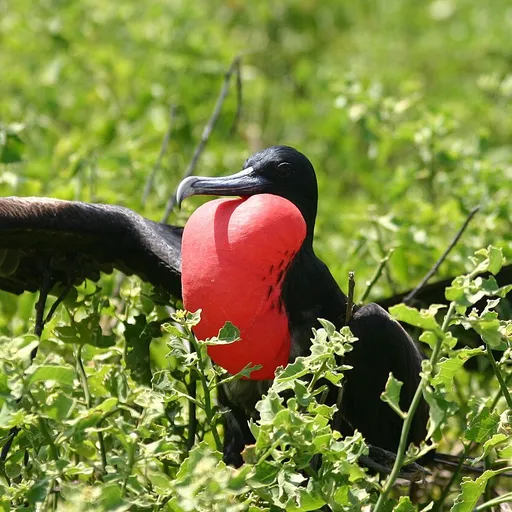
- During the breeding season, males inflate a striking red gular sac into a balloon-like shape to attract mates.
- Juveniles display black plumage with a rust-tinged white face, head, and throat.
Habitat
Found throughout the world's tropical seas, major nesting populations exist in the Pacific (including Hawaii and the Galápagos), the Indian Ocean (Seychelles, Mauritius), and the South Atlantic (St. Helena). These colonial birds nest in bushes and trees, or on the ground where vegetation is absent, often sharing sites with other seabird species such as red-footed boobies.
Diet
The great frigatebird forages in pelagic waters within 80 km of its colonies, primarily snatching flying fish from the air or just below the surface while in flight. It occasionally supplements its diet by hunting seabird chicks or attempting kleptoparasitism on other nesting birds, although this behaviour is less frequent than in other frigatebird species.
Did you know?
The great frigatebird possesses the highest ratio of wing area to body mass and the lowest wing loading of any bird, a trait hypothesised to allow it to exploit marine thermals created by temperature differences between tropical air and water.
Sources
- Wikipedia · CC BY-SA 4.0
- Wikidata · CC0 1.0