
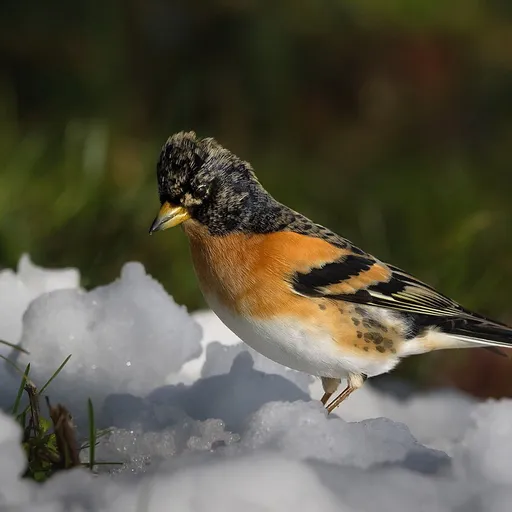
Brambling
Fringilla montifringilla
Least Concern
Listen
XC707500 · Sonothèque ADVL · Carolles, Manche, Normandie, France · CC0 1.0
Overview
The brambling (Fringilla montifringilla) is a small passerine bird in the finch family that is widespread and migratory. It is often seen in very large flocks, particularly during the winter season.
Identification
- Size: Similar in size and shape to a common chaffinch, with a length of 16 cm, weight of 23–29 g, and wingspan of 25–26 cm.
- Plumage: Breeding-plumaged males have a black head, dark upperparts, orange breast, and white belly; females and younger birds are less distinct. All plumages feature an orange breast contrasting with a white belly, dark-spotted flanks, and orange scapulars, distinguishing them from chaffinches which have grey-green rumps and plain flanks.
- Bill: Yellow in most plumages, but black in breeding-plumaged males.
- Tail: Lacks the white outer tail feathers found in common chaffinches.
Habitat
During the breeding season, the brambling is found throughout the forests of northern Europe and east across the Palearctic, favouring open coniferous or birch woodland. It is migratory, wintering in southern Europe, North Africa, northern India, northern Pakistan, China, and Japan, with occasional strays in Alaska, the northern United States, and southern Canada.
Diet
Bramblings mostly eat seeds in winter and insects in summer. In winter, large flocks will move to find abundant beech mast, though this is not a strict dietary requirement.
Did you know?
The English name 'brambling' derives from an older term meaning 'loud lung', yet the bird is not associated with the bramble or common blackberry (Rubus fruticosus) despite the name's etymological appearance.
Sources
- Wikipedia · CC BY-SA 4.0
- Wikidata · CC0 1.0