
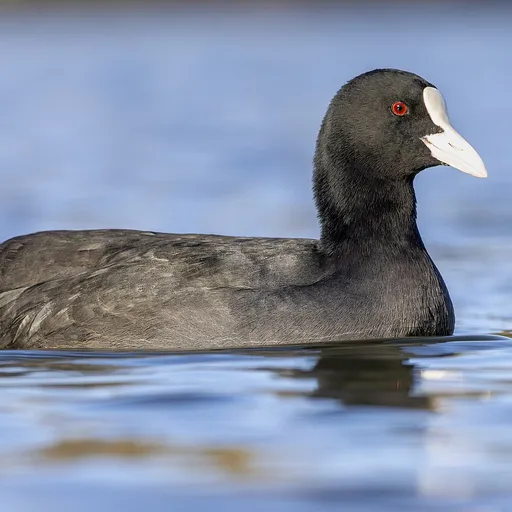
Eurasian Coot
Fulica atra
Least Concern
Listen
XC834775 · Grégoire Chauvot · Lidingö, Danderyd Municipality, Stockholms län, Sweden · CC0 1.0
Overview
The Eurasian coot (Fulica atra), also known as the common coot, is a member of the rail and crake bird family, the Rallidae. It is a widespread waterbird found across Europe, Asia, Australia, New Zealand, and parts of North Africa. The species is currently listed as Least Concern on the IUCN Red List.
Identification
- Plumage and Markings: Largely slaty-black body with a glossy black head, distinguished by a stark white bill and frontal shield.
- Size and Build: Measures 36–38 cm in length with a wing-span of 70–80 cm; males weigh around 890 g and females 750 g.
- Voice: A noisy bird producing a wide repertoire of crackling, explosive, or trumpeting calls, often heard at night.
- Juvenile Appearance: Paler than adults with a whitish breast and lacking the facial shield until about one year of age.
Habitat
The Eurasian coot breeds across much of the Old World on freshwater lakes and ponds, and has adapted well to urban environments where it is often found in parks and gardens with access to water. It is resident in milder parts of its range but migrates further south and west from much of Asia in winter to avoid freezing waters. The species has recently expanded its range into New Zealand and is known as a vagrant in North America.
Diet
As an omnivore, the coot consumes algae, vegetation, seeds, and fruit, as well as small live prey including the eggs of other water birds. It shows considerable variation in foraging techniques, grazing on land or in the water, where it may upend or dive to search for food.
Did you know?
Coots can be brutally violent towards their own offspring when under pressure, such as a lack of food, biting begging chicks repeatedly until they stop or even killing them. They also bite the beaks of chicks to stop begging, which can result in death if the behaviour continues.
Sources
- Wikipedia · CC BY-SA 4.0
- Wikidata · CC0 1.0