
Giant Coot
Fulica gigantea
Least Concern
Overview
The giant coot (Fulica gigantea) is a large, flightless bird belonging to the rail family found in South America. It is the second-largest extant member of its family, surpassed only by the takahē, and is classified as a species of Least Concern by the IUCN.
Identification
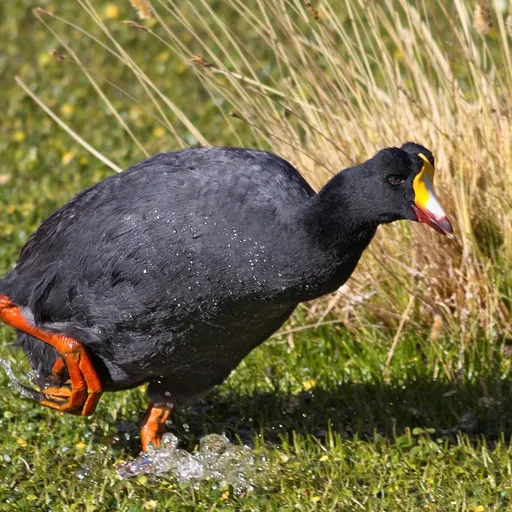
- Adults possess a bulky body with disproportionately small heads and deep slaty grey plumage that is blacker on the head and neck.
- Distinguished from other coots by deep red legs and feet, a deep red bill with a yellow base, and a yellow frontal shield.
- Males produce alternating gobbling or laughing 'houehouhouhouhoou' and low, growling 'hrr' or 'horr' sounds, while females emit low, crackling 'chee-jrrrh' noises.
Habitat
Found across southern Peru, western Bolivia, northern Chile, and northwestern Argentina, this species inhabits the Altiplano region. It favours ponds and lakes with weedy shallows at high elevations, primarily between 3,600 and 5,000 m, though it can be found as high as 6,540 m.
Diet
The giant coot feeds mostly on aquatic vegetation, specifically plants of the genera Myriophyllum, Potamogeton, Zannichellia, and Ruppia, while shunning Chara. It forages at the water surface, occasionally dabbles or dives, and grazes on shore.
Did you know?
Adults are too heavy to fly, although immature birds are smaller and readily take to the air, typically dispersing by flying at night.
Sources
- Wikipedia · CC BY-SA 4.0
- Wikidata · CC0 1.0