
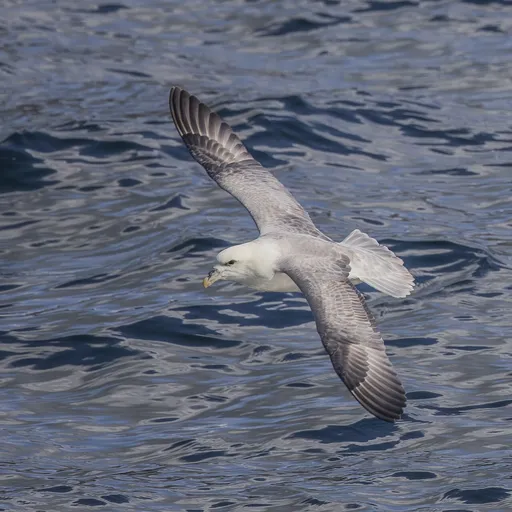
Northern Fulmar
Fulmarus glacialis
Least Concern
Overview
The northern fulmar is an abundant seabird primarily found in the subarctic regions of the North Atlantic and North Pacific oceans. Although it resembles gulls, it is a member of the storm-petrel family Procellariidae and is characterised by its long-lived nature and high resilience.
Identification
- Wingspan of 102–112 cm and a length of 46 cm, appearing bull-necked compared to gulls.
- Plumage varies by morph, ranging from a light morph with a white head and body and grey wings to a dark, uniformly grey morph.
- Features a pale yellow, thick bill and bluish legs.
- Emits grunting and chuckling sounds while eating, and guttural calls during the breeding season.
Habitat
This species inhabits subarctic regions of the North Atlantic and North Pacific, with one confirmed sighting in the Southern Hemisphere near New Zealand. During the breeding season, adults typically remain within 500 km of their colonies, which consist of scrapes on grassy ledges or saucers of vegetation, though they have recently begun nesting on rooftops and buildings.
Diet
Northern fulmars feed on shrimps, fish, squid, plankton, jellyfish, carrion, and refuse. They will dive up to 4 metres deep to retrieve fish prey.
Did you know?
Stomach contents of northern fulmars contain microplastics in 89.5% of individuals, making them a key indicator of marine debris. They also produce a stomach oil made of wax esters that can be sprayed to mat the plumage of avian predators and potentially cause their death.
Sources
- Wikipedia · CC BY-SA 4.0
- Wikidata · CC0 1.0