
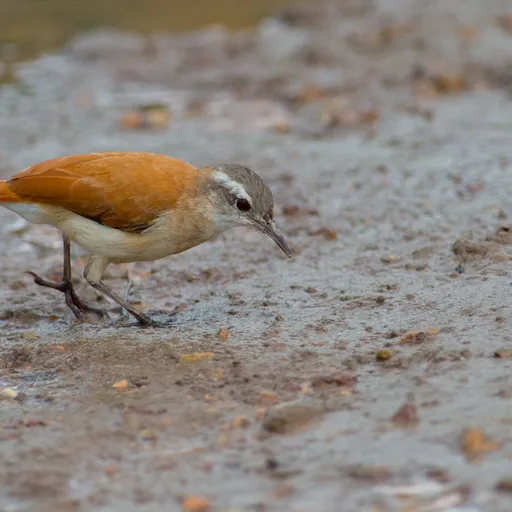
Lesser Hornero
Furnarius minor
Least Concern
Listen
XC248781 · Niels Krabbe · Orellana: river island at Añangu, Ecuador · CC BY-SA 4.0
Overview
The lesser hornero (Furnarius minor) is a very small species of ovenbird in the family Furnariidae that is closely related to the pale-legged hornero. Classified as a river specialist, this monotypic species is native to the Amazon River basin and its major tributaries.
Identification
- Length of 12 to 13 cm with a mass of 23 to 29 g.
- Grey head featuring a prominent white stripe above the eye and a white throat.
- Rufous rump and wings, with tawny-buff breast and flanks that become paler lower down.
- Long, straight bill.
- Both sexes are identical in appearance.
Habitat
Distributed across Brazil, Colombia, Ecuador, and Peru, specifically along the banks of the Amazon River and its major tributaries between 50 and 200 m above sea level. The bird inhabits river island scrub and early successional scrub along white-water river edges and young islands, as well as the understory of Cecropia forests in Peru, habitats that are patchily distributed and dependent on seasonal flooding.
Diet
The lesser hornero feeds on arthropods and other invertebrates. It hunts either individually or in pairs, foraging for prey on the ground, river-shore mud, or low branches, often within dense cover.
Did you know?
Like other members of its genus, this species builds a distinctive mud 'oven' nest in tree branches that is lined with grasses and hair. It has been recorded building its nests in November and incubating eggs in January, although little else is known about its nesting habits.
Sources
- Wikipedia · CC BY-SA 4.0
- Wikidata · CC0 1.0