
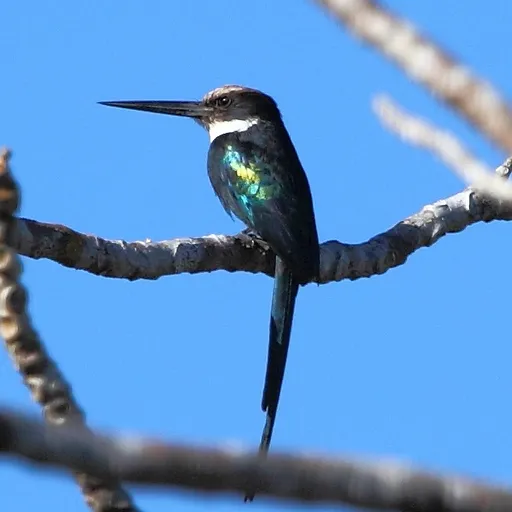
Paradise Jacamar
Galbula dea
Least Concern
Overview
The Galbula dea is a species of bird belonging to the family Galbulidae, found throughout much of the Amazon Basin in South America. It was formally described by Carl Linnaeus in 1758 and is classified as Least Concern on the IUCN Red List.
Identification
- Length ranges from 25.5 to 34 cm, with a weight of 25 to 32.5 g.
- Nominate subspecies possess a dark brown crown and glossy black upper parts, contrasting with a white throat and upper breast and blackish underparts.
- The song is a sequence of well-spaced 'peep' notes that usually descend, becoming slightly faster and weaker towards the end.
- Calls include single notes described as 'pip', 'peeap' or 'glewweh'.
Habitat
The species inhabits terra firme, várzea, and savanna forests, as well as dry and gallery forests, primarily in edges or open areas like clearings and treefalls. It is typically found at elevations below 500 m, though it can occur locally up to 1,100 m, and is usually seen in the canopy rather than the mid-level.
Diet
The paradise jacamar feeds primarily on Lepidoptera, Odonata, Diptera, and Hymenoptera, alongside other flying insects. It forages by perching on exposed branches singly, in pairs, or in small groups to sally out for prey, and may occasionally join mixed-species foraging flocks in the canopy.
Did you know?
A pair of paradise jacamars was observed excavating a burrow in an arboreal termite nest, and pairs are frequently seen near such nests, although no other breeding phenology has been recorded.
Sources
- Wikipedia · CC BY-SA 4.0
- Wikidata · CC0 1.0