
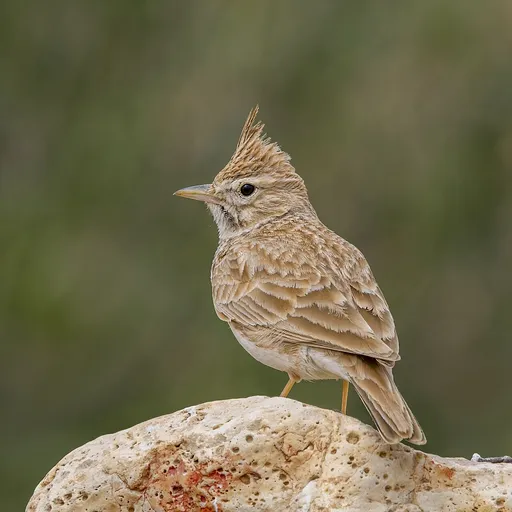
Thekla's Lark
Galerida theklae
Least Concern
Overview
Galerida theklae, also known as the Thekla lark, is a smallish, sedentary bird of the lark family that breeds across the Iberian Peninsula and North and East Africa. It is a common inhabitant of dry, open landscapes, often found at some altitude, and is currently listed as a species of least concern by the IUCN.
Identification
- A smallish lark, slightly smaller than the Eurasian skylark, with a long, spiky, erectile crest.
- Predominantly brownish-grey with a greyer back and rump than the crested lark, featuring a breast streaked with black.
- The body is mainly dark-streaked grey above and whitish below, with grey underwings visible in flight.
- The song is melodious and varied, characterised by mournful whistles and mimicry, and is softer and more tuneful than that of the crested lark.
Habitat
The species is native and resident in parts of southern France, the Iberian Peninsula, and across North and East Africa down to Kenya. Its typical habitat consists of rugged areas with scrub, bare patches of ground, and semi-arid grassland.
Diet
Thekla's lark feeds on weeds, seeds, and insects, with the latter being especially popular during the breeding season.
Did you know?
The bird was named by Alfred Edmund Brehm in 1857 in honour of his recently deceased sister, Thekla Brehm.
Sources
- Wikipedia · CC BY-SA 4.0
- Wikidata · CC0 1.0