
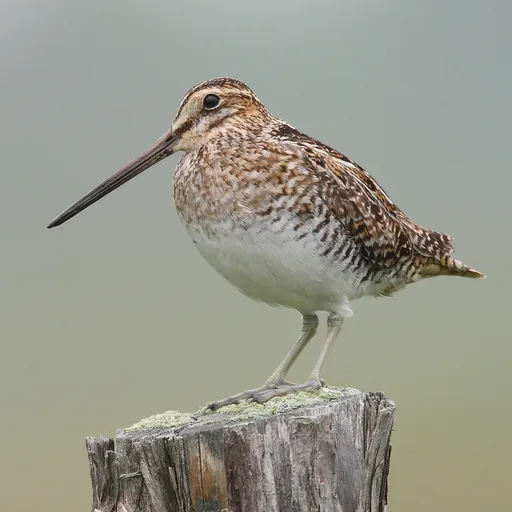
Wilson's Snipe
Gallinago delicata
Least Concern
Listen
XC609619 · Doug Hynes · "the Fen", near Churchill Northern Studies Centre, Manitoba, Canada · CC BY-SA 4.0
Overview
Wilson's snipe (Gallinago delicata) is a small, stocky shorebird that was previously considered a subspecies of the common snipe until 2003. It is currently classified as a species of Least Concern on the IUCN Red List, though it has historical ties to the American ornithologist Alexander Wilson, for whom the common name was derived.
Identification
- Measures 23–28 cm in length with a 39–45 cm wingspan, weighing between 79 and 147 g.
- Features mottled brown upperparts, pale underparts, and a dark stripe through the eye bordered by light stripes.
- Possesses short greenish-grey legs and a very long, straight dark bill with pointed wings.
- Distinguished from the common snipe by a narrower white trailing edge on the wings and eight pairs of tail feathers rather than seven.
Habitat
Breeds in marshes, bogs, tundra, and wet meadows across Canada, the northern United States, and the Chukchi Peninsula in Russia. The species is a year-round resident on the U.S. Pacific coast, while the eastern population migrates to the southern United States, the Caribbean, and northern South America.
Diet
Forages in soft mud by probing or picking up food by sight, consuming insects, earthworms, and plant material. The bird is well-camouflaged and shy, typically concealing itself close to ground vegetation and flushing only when approached closely.
Did you know?
During courtship, the male performs a 'winnowing' display by flying high in circles and taking shallow dives to create a distinctive sound similar to that of a boreal owl. This display can continue throughout the day and long into the night.
Sources
- Wikipedia · CC BY-SA 4.0
- Wikidata · CC0 1.0