
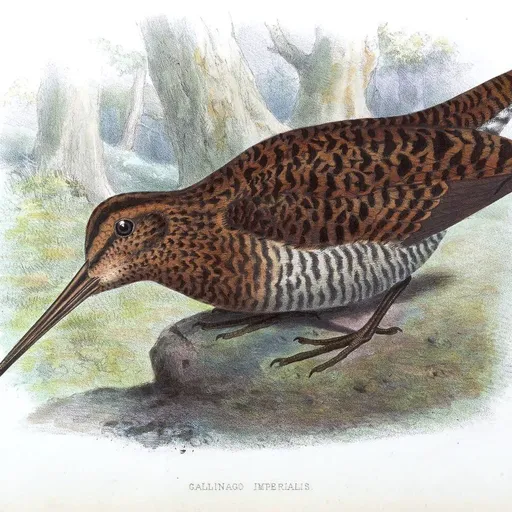
Imperial Snipe
Gallinago imperialis
Near Threatened
Listen
XC250857 · Niels Krabbe · Zamora-Chinchipe: Reserva Tapichalaca páramo, Ecuador · CC BY-SA 4.0
Overview
The Gallinago imperialis is a small, stocky wader that breeds in the Andes. Once presumed extinct for a century after being known only from two specimens near Bogotá, it was rediscovered in Peru in 1967 and Ecuador in 1988. It is currently classified as Near Threatened.
Identification
- 29–31 cm long with a stocky body and relatively short, grey legs.
- Adult plumage is dark rufous brown, except for the lower belly and undertail, which are white with heavy brown barring.
- Features a long, straight, robust grey bill; the sexes are similar in appearance.
- In flight, it appears heavy, broad-winged and short-tailed, with a banded belly contrasting against a dark breast.
- Produces a shatteringly loud, raucous song during display, often accompanied by a drumming sound from modified outer tail feathers.
Habitat
It occurs around the tree-line at altitudes of 2,745–3,700 m in mosaic habitats comprising bogs, mossy areas, moist elfin forest, tree-ferns, and tall grass. Its range includes sites in Peru and Ecuador, though populations appear at very low densities in suitable ridge-top habitat.
Diet
The specific diet of the Gallinago imperialis is unknown, but it is expected to forage for insects and worms by probing with its long bill, similar to other snipe species.
Did you know?
For over half a century, the bird was presumed extinct after being known only from two specimens collected near Bogotá, Colombia, until it was rediscovered in Peru in 1967. During its aerial display, it produces a drumming sound caused by the vibrations of modified outer tail feathers.
Sources
- Wikipedia · CC BY-SA 4.0
- Wikidata · CC0 1.0