
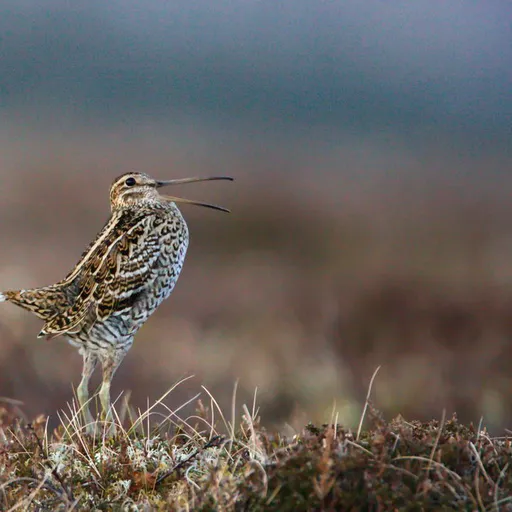
Great Snipe
Gallinago media
Near Threatened
Listen
XC994704 · Robert Petersen · Knivbergavägen, Norrköping Municipality, Östergötland County, Sweden · CC BY-SA 4.0
Overview
The great snipe (Gallinago media) is a small, stocky wader in the genus Gallinago that is intermediate in size between the woodcock and the common snipe. It is a migratory species that breeds in northeastern Europe and northern Asia before wintering in tropical Africa. Currently classified as Near Threatened by the IUCN, the species is experiencing a steep population decline, particularly in Europe, primarily due to habitat loss.
Identification
- Measures 26–30 cm in length with a 43–50 cm wingspan, appearing noticeably bulkier than the common snipe and more reminiscent of a woodcock in flight.
- Plumage is mottled brown on top and barred underneath, with a dark stripe through the eye; broad wings feature a pale wingbar visible in flight, and the tail has a brown centre with white sides.
- Bill is short, measuring 6–7 cm, shorter than that of the common snipe.
- Voice includes a faint yeah, while mating display calls are described as a mixture of firecracker and wind-up xylophone sounds that can be heard from over 300 m away.
Habitat
Breeding habitat consists of marshes and wet meadows with short vegetation across northeastern Europe and northern Asia, ranging from Scandinavia and Poland east across northern Russia to western Siberia and south to northern Kazakhstan. The species is migratory, spending the winter in tropical Africa. Its European breeding population is currently in steep decline.
Diet
Great snipe forage in soft mud within dense vegetation, though they typically prefer drier habitats than the common snipe. They feed by probing or picking up food by sight, consuming mainly insects and earthworms, along with occasional plant material.
Did you know?
This species is capable of remarkable non-stop flights, with one individual recorded reaching an altitude of 8,700 metres, possibly the highest altitude ever recorded for a migrating bird. During these vast journeys, which can last up to 90 hours, the birds do not stop to feed and rely entirely on stored fat to sustain their flight.
Sources
- Wikipedia · CC BY-SA 4.0
- Wikidata · CC0 1.0