
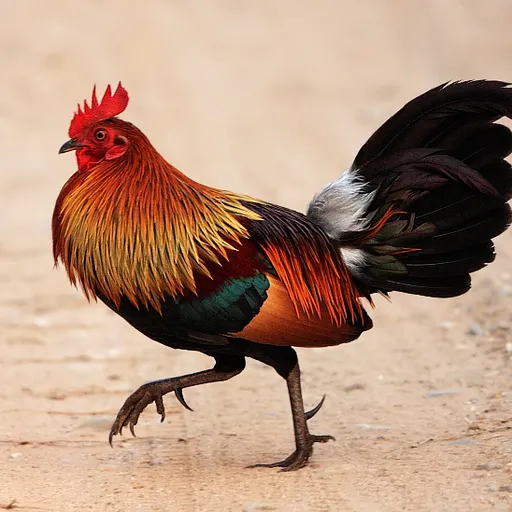
Red Junglefowl
Gallus gallus
Least Concern
Overview
The red junglefowl (Gallus gallus), also known as the Indian red junglefowl, is a tropical galliform bird found across much of Southeast and parts of South Asia. It is the primary species responsible for giving rise to the domestic chicken, with domestication estimated to have begun approximately 8,000 years ago.
Identification
- Males exhibit significant sexual dimorphism, featuring a large comb, wattle, and golden hackle feathers on the neck and back, while females are drab and suited for camouflage.
- Male tails consist of 14 iridescent feathers shimmering with blue, purple, and green, some of which are long, curved, and can grow up to 28 cm in length.
- Roosters have sharp, bony spurs on the back of each leg, just behind the foot, used for defence and establishing dominance.
- Males produce a distinctive 'cock-a-doodle-doo' crow that cuts off abruptly at the end, which is shorter than the call of domestic roosters.
Habitat
Red junglefowl prefer disturbed habitats and edges, including deforested and regenerating forests, as well as areas of regrowth from slash-and-burn agriculture. Their native range extends from Pakistan, India, Nepal, Bhutan, and Bangladesh eastwards across southern China to Myanmar, Thailand, Cambodia, Laos, and Vietnam, and south into Malaysia, Singapore, the Philippines, Indonesia, and Timor-Leste.
Diet
Red junglefowl forage for fallen fruits, seeds, grasses, leaves, roots, and tubers, while also capturing arthropods, small lizards, and occasionally mammalian faeces. They are attracted to areas with ripe fruit, such as fruit plantations, domestic grain fields, and bamboo stands, and sometimes forage in trees by perching on branches. Chicks consume mostly adult and larval insects and earthworms, whereas adults eat a higher proportion of plant material than animal matter.
Did you know?
Females in free-ranging feral flocks choose to mate with subordinate males approximately 40% of the time, despite dominant males attempting to maintain exclusive reproductive access. Junglefowl have distinctive alarm calls for aerial and ground predators, to which other members of the flock react appropriately.
Sources
- Wikipedia · CC BY-SA 4.0
- Wikidata · CC0 1.0