
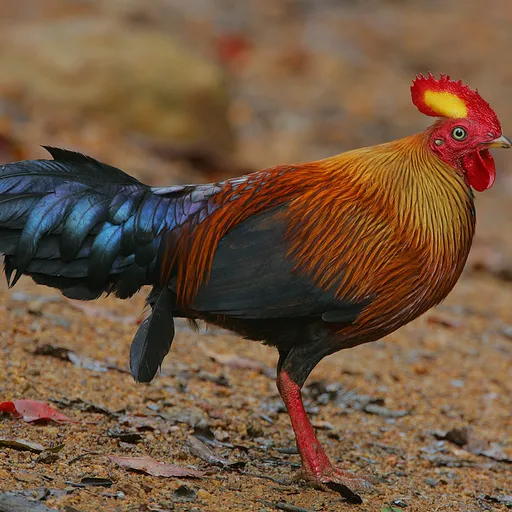
Sri Lanka Junglefowl
Gallus lafayettii
Least Concern
Overview
The Sri Lankan junglefowl (Gallus lafayettii), also known as the Ceylon junglefowl or Lafayette's junglefowl, is a common endemic bird in Sri Lanka and the country's national bird. It is a member of the order Galliformes and is closely related to the red junglefowl, though more closely related to the grey junglefowl.
Identification
- Males: Range from 66–72 cm in length, resembling large, muscular roosters with orange-red body plumage and dark purple to black wings and tail. Feathers of the mane are golden, and the face features bare red skin and wattles with a red comb having a yellow centre.
- Females: Much smaller at 35 cm in length, with dull brown plumage and white patterning on the lower belly and breast, providing ideal camouflage.
- Sound: Males utter short calls such as "kreeu, kreeu, kreeuu" while foraging and high-pitched crowing "cor-cor-chow" at dawn; females produce "kwikkuk, kwikkukkuk" sounds.
Habitat
It is common in forests and scrub habitats, found from sea level up to 2,000 metres of elevation. Commonly spotted locations include Kitulgala, Yala, and Sinharaja.
Diet
Primarily terrestrial, they forage by scratching the ground for seeds, fallen fruit, and insects. Chicks require a constant diet of live food, including insects, isopods such as sowbugs and pillbugs, and juveniles of land crabs, which are highly important to their growth and survivability.
Did you know?
The Sri Lankan junglefowl exhibits the unique reproductive strategy of facultative polyandry, where a single female is typically linked with two or three male siblings who form a pride, with the alpha male guarding the nest and beta males defending the territory. They are also unique amongst junglefowl for the brevity of their incubation period, which may be as short as 20 days.
Sources
- Wikipedia · CC BY-SA 4.0
- Wikidata · CC0 1.0