
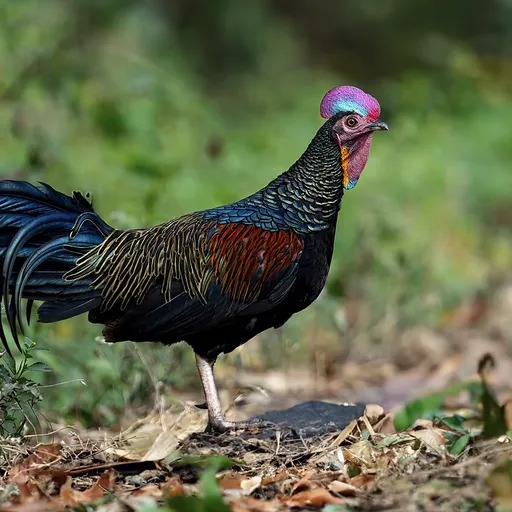
Green Junglefowl
Gallus varius
Least Concern
Overview
The green junglefowl, also known as the Javan junglefowl or forktail, is a medium-sized bird belonging to the pheasant family. It is the most distantly related of the four junglefowl species, having diverged at least four million years ago, and is classified as Least Concern by the IUCN.
Identification
- Males display an iridescent mantle of blue, gold, and bronze scales, while females are predominantly brown with occasional green feathers.
- The male features a light blue comb that transitions to purple or red, accompanied by bare facial skin that appears scarlet red with electric yellow patches near the ears.
- This medium-sized bird reaches up to 75 cm in length.
Habitat
Endemic to Java, Bali, Lombok, Komodo, Flores, and Rinca in Indonesia, the species inhabits subtropical and tropical lowland moist forests, shrubland, and arable land from sea level up to 2,000 m. It has also established a small wild population in the introduced Cocos (Keeling) Islands, where it is observed flying between islands and breeding along coastal areas.
Diet
The reference material does not explicitly detail wild foraging methods, but notes that in captivity they are fed grains, seeds, fruit, and insects, which constitute the same diet they consume in the wild.
Did you know?
Hybrids between the green junglefowl and domestic chickens, known as bekisar, produced plumage so unlike either parent that 19th-century ornithologists mistook them for distinct species, a confusion that prompted Charles Darwin to investigate the origin of the domestic chicken.
Sources
- Wikipedia · CC BY-SA 4.0
- Wikidata · CC0 1.0