
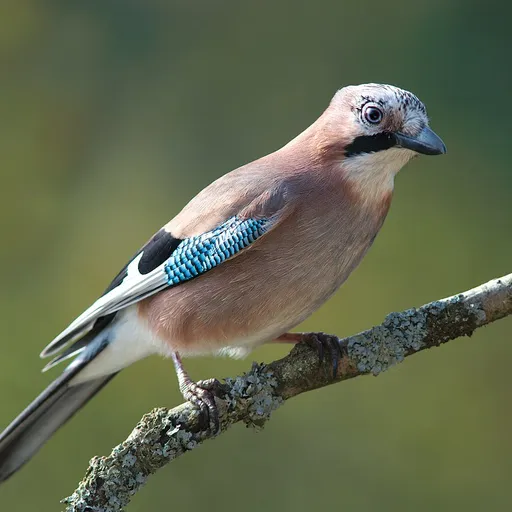
Eurasian Jay
Garrulus glandarius
Least Concern
Listen
XC707402 · Sonothèque ADVL · Carolles, Manche, Normandie, France · CC0 1.0
Overview
The Eurasian jay (Garrulus glandarius) is a relatively small passerine bird in the family Corvidae, currently listed as Least Concern by the IUCN. It is a woodland bird with a vast range that includes several distinct racial forms.
Identification
- Plumage: Light rufous brown to pinkish brown body with a whitish throat bordered by black moustache stripes, a white rump, and a black tail.
- Wings: Upper surface features black and white bars with a prominent bright blue patch containing fine black bars.
- Size: Similar in size to a western jackdaw, measuring 34–35 cm in length with a 52–58 cm wingspan.
- Voice: Characterised by a harsh, rasping screech used for advertising and alarms, as well as remarkable mimicry of birds of prey like the common buzzard and Eurasian goshawk.
Habitat
The Eurasian jay inhabits mixed woodland, particularly areas with oaks, and has recently begun migrating into urban areas due to woodland erosion. Its range extends from western Europe and north-west Africa to the Indian subcontinent, the eastern seaboard of Asia, and south-east Asia.
Diet
Feeding in trees and on the ground, it consumes a wide range of invertebrates, acorns, beech and other seeds, fruits such as blackberries and rowan berries, young birds, eggs, bats, and small rodents. It is a prolific cacher, burying oak acorns and beechnuts for winter and spring, with caching activity most intense in autumn.
Did you know?
To keep its plumage free from parasites, the jay lies on top of anthills with its wings spread, allowing its feathers to be sprayed with formic acid. Additionally, male jays plan for future needs and even consider their partner's desires when sharing food as a courtship ritual.
Sources
- Wikipedia · CC BY-SA 4.0
- Wikidata · CC0 1.0