
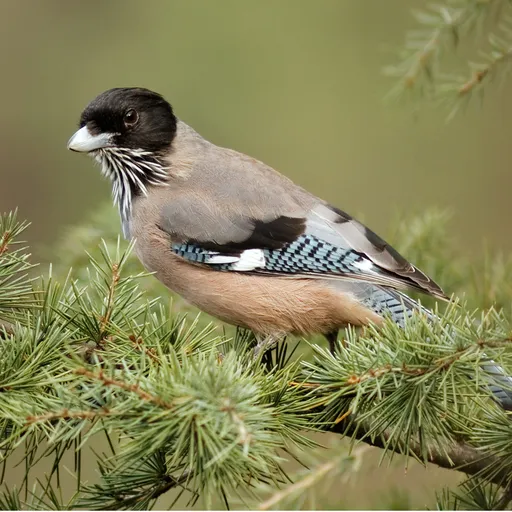
Black-headed Jay
Garrulus lanceolatus
Least Concern
Overview
The black-headed jay, or lanceolated jay (Garrulus lanceolatus), is a passerine bird in the crow family Corvidae found in open wooded country across the Himalayas and eastern Afghanistan. It is a non-migratory species that inhabits areas with large open grounds rather than dense forest, ranging from 570 to 4000m in elevation.
Identification
- Largely grey body with a black head, an untidy crest, and white streaks on the throat.
- Roughly the same size as the Eurasian jay but more slender, with a longer tail.
- Pale bill that is slightly shorter and thicker than that of the Eurasian jay.
- Voice similar to the Eurasian jay but with longer pauses, often producing a harsh, raspy or nasal "kraaa".
Habitat
This species is found in wooded country with large areas of open ground rather than dense forest, at elevations between 570 and 4000m. Its range extends from eastern Afghanistan eastwards across the Himalayas to India, Nepal, and Bhutan. It also occurs in cultivated areas and near villages where trees and scrubland are nearby.
Diet
Black-headed jays are omnivores that feed both on the ground and in trees, consuming a wide range of plant and animal foods including eggs and nestlings. They are bold and frequent human habitation, often feeding off agricultural land and garbage dumps.
Did you know?
The genus name Garrulus is a Latin word meaning "chattering", "babbling" or "noisy". The specific epithet lanceolatus translates to "lance-shaped" or "spear-shaped".
Sources
- Wikipedia · CC BY-SA 4.0
- Wikidata · CC0 1.0