
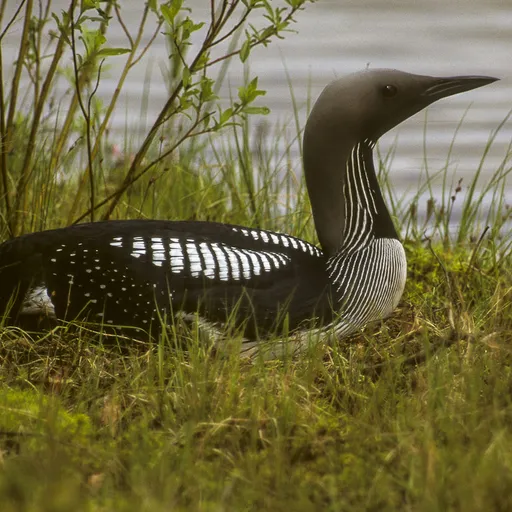
Black-throated Loon
Gavia arctica
Least Concern
Overview
The black-throated loon (Gavia arctica), also known as the Arctic loon, is a migratory aquatic bird found in the Northern Hemisphere that primarily breeds in freshwater lakes in northern Europe and Asia. It winters along the sheltered, ice-free coasts of the north-east Atlantic Ocean and the eastern and western Pacific Ocean.
Identification
- Measures 58 to 73 cm in length with a wingspan of 100 to 130 cm.
- In breeding plumage, the nominate subspecies has a grey head, black throat, and white flanks that distinguish it from the Pacific loon.
- Vocalisations include a loud, rhythmic whistling song described as "oooéé-cu-cloooéé-cu-cluuéé" and a barking "kwow" flight call.
Habitat
Breeding occurs across northern Europe, Asia, and the Seward Peninsula in Alaska, typically in isolated, deep freshwater lakes larger than 0.1 square kilometres. During the non-breeding season, the bird moves towards ice-free sea coasts, particularly in the north-east Atlantic and the Pacific, though it may also be found inland in the Mediterranean and Black seas.
Diet
This top predator in subarctic lakes feeds on fish, insects, molluscs, crustaceans, and plant matter. It forages by itself or in pairs, diving from the water to depths of no more than 5 metres.
Did you know?
The black-throated loon takes off by pattering on a 'runway' of water, as it does not take flight well from stationary water. Most of its dives are successful, with an average of about 80 per cent yielding prey.
Sources
- Wikipedia · CC BY-SA 4.0
- Wikidata · CC0 1.0