
Common Loon
Gavia immer
Least Concern
Overview
The common loon, also known as the great northern diver, is a large member of the loon family characterised by its expert diving abilities. It is a migratory waterbird that breeds in northern North America and parts of the Arctic, wintering along coasts and large inland waters.
Identification
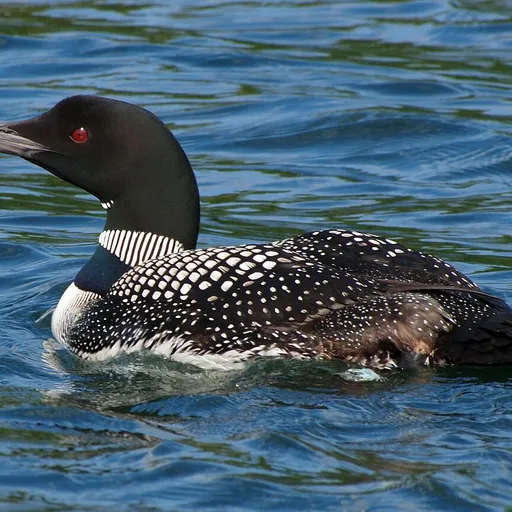
- Breeding adults feature a broad black head and neck with a greenish, purplish, or bluish sheen, blackish upperparts, and pure white underparts.
- Distinctive neck markings include two white necklaces on the upper foreneck and a large white collar on the sides.
- Non-breeding adults appear brownish with a dark neck and head, dark brownish-grey upperparts, and whitish underparts.
- The species possesses a heavy, dagger-like bill that is greyish with a black tip and red eyes in breeding plumage.
Habitat
During the breeding season, common loons inhabit lakes and waterways across Canada, the northern United States, and parts of Greenland, Iceland, and Svalbard, preferring deep lakes with islands for predator protection. In winter, they migrate to coastal areas, bays, and large inland lakes in North America, as well as the Atlantic coasts of Europe, avoiding waters that freeze over.
Diet
Fish constitute approximately 80% of the common loon's diet, with the bird foraging on species up to 26 cm long, such as minnows, whitefish, and walleye. It catches prey underwater by diving as deep as 60 m, swallowing most items directly but bringing larger fish to the surface first.
Did you know?
The common loon has a skeletal structure composed of solid bones rather than the hollow, air-filled bones typical of most flying birds, a trait that adds weight but facilitates its diving capabilities. Its North American name 'loon' is derived from Old Norse, referring to the bird's distinctive call.
Sources
- Wikipedia · CC BY-SA 4.0
- Wikidata · CC0 1.0