
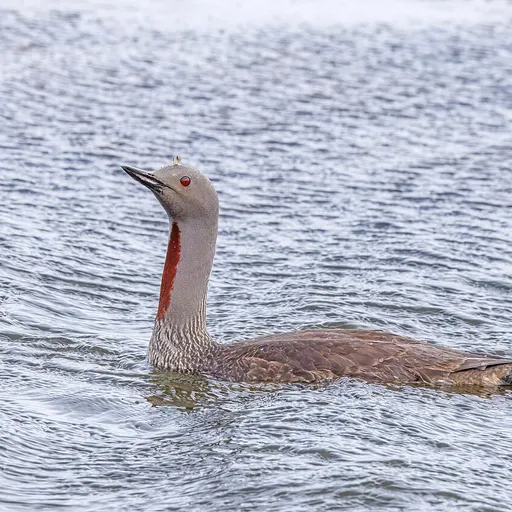
Red-throated Loon
Gavia stellata
Least Concern
Listen
XC803906 · Grégoire Chauvot · Leksand Municipality, Dalarnas län, Sweden · CC0 1.0
Overview
The red-throated loon, or red-throated diver, is a migratory aquatic bird and the smallest and lightest of the world's loon species. It is the most widely distributed member of the family Gavidae, breeding primarily in Arctic regions and wintering in northern coastal waters. Classified as Least Concern by the IUCN, it has a large global population despite some regional declines.
Identification
- Size: Smallest and lightest loon, ranging from 53 to 69 cm in length with a wingspan of 91–120 cm.
- Plumage: In breeding plumage, features a dark grey head and neck, a triangular red throat patch, white underparts, and a dark grey-brown mantle; it is the only loon with an all-dark back in breeding plumage. Non-breeding plumage is drabber with a white chin and face, grey head, and white speckling on the dark mantle.
- Bill: Thin, straight, and sharp, held at an uptilted angle; black in summer and pale grey in winter.
- Flight: Distinctive hunchbacked profile with head and neck drooping below the horizontal, small feet not projecting far past the body, and a quicker, deeper wingbeat than other loons.
Habitat
Breeds primarily in Arctic regions of northern Eurasia and North America, usually north of 50°N latitude, often using very small freshwater lakes for nesting. Winters in northern coastal waters, ranging from the Pacific and Atlantic coasts as far south as China, Japan, and parts of Spain, and also uses major inland waterways. Unlike other loons, it nests in small lakes but feeds in larger lakes or the sea.
Diet
Primarily a fish-eater, though it also consumes molluscs, crustaceans, frogs, aquatic invertebrates, insects, fish spawn, and occasionally plant material. It seizes prey rather than spearing it, capturing food underwater during pursuit dives that range from 2 to 9 metres in depth. Young are initially fed aquatic insects and small crustaceans by both parents before switching to small fish after a few days.
Did you know?
The red-throated loon is the only species of loon able to take off directly from land, though it remains clumsy on the ground due to its set-back legs. It undergoes a simultaneous wing moult, losing all flight feathers at once and becoming flightless for three to four weeks between late summer and late autumn, unlike other loons which moult in late winter.
Sources
- Wikipedia · CC BY-SA 4.0
- Wikidata · CC0 1.0